E-commerce Search Demo
AI Assisted Filters
Parameters
Query:
Category filters: All
AI Assist: ON
Page: 1
Products
Time taken: 3 Max score: 1000.000 Total hits: 100 Full time: 0.0 s
Showing 1-10 of 100 products
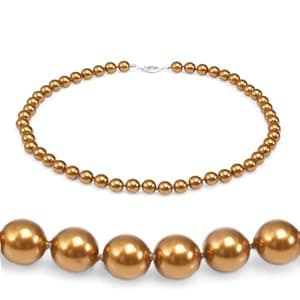 B001IQ1WNO Availability: Currently unavailable Score: 1000.000 Category: Clothing Rating: 3.6 Votes: 41 Find similar productsNvie Designs Simulated Crystal Pearl Necklace - Made with Swarovski Elements - 14 Colors. This Genuine Swarovski Crystal Pearl Necklace is beautiful and elegant. At 18 long, it is carefully hand strung on finest quality silk thread. It is finished with a sterling silver Fish Hook Filigree Clasp. Buy this necklace with its matching earrings and bracelet. At these wholesale prices, this piece is a steal. The Secret Of Swarovski Crystal Pearls : Each Swarovski Crystal Pearl is created around a crystal core, hence the name Crystal Pearl. This crystal core gives the pearl its ideal weight and combined with the Swarovski Pearl coating it causes each Crystal Pearl to glow from within. The pearl coating developed by Swarovski is applied around the crystal core in pearly layers. The high specific gravity of a raw pearl made of crystal gives the Swarovski Crystal Pearl the same weight as a cultured pearl. Swarovski crystal pearls look very high quality with its superior lustre. These are better to maintain than cultured pearls. They do not get stained by sweat. A Swarovski Crystal Pearl feels good to the touch and as a piece of jewelry, it offers that sensual experience valued by pearl enthusiasts. Occasions : Wear these to a party, weddings, formal occasions or just to work everyday. Pearls are always appropriate no matter what the occasion.Just try it and we know you will love it. | 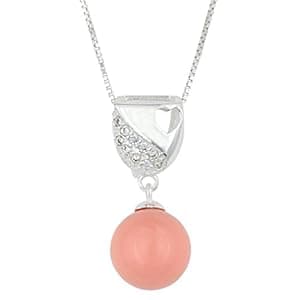 B013JZE094 Availability: Currently unavailable Score: 12.195 Category: Clothing Rating: 5 Votes: 1 Find similar productsSterling Silver Pendant Necklace with Swarovski Simulated Coral Pink Pearl, 18. This jewelry is a classic and elegant gift for her. Erika & Alex jewelry quality products always made with passion and love, nicely presented in gift packaging. Product dimensions displayed in pictures. Made in England with Swarovski Simulated Pearls. Crystal Pearls by Swarovski are pearls made with a crystal core. Their unparalleled harmonious and lustrous shimmer is achieved using a unique coating technology developed by Swarovski. It is the first production method in the world to combine the quality of a perfect crystal core with the exquisite beauty of a pearl coating. The innovative technology by Swarovski gives the pearl a mysterious glow, which appears to be radiating from within the pearl itself. The strictest quality controls help ensure the absolute flawlessness of each Crystal Pearl. (c) Swarovski FAQ. |
 B003ODIQ6K Availability: Currently unavailable Score: 11.765 Category: Clothing Rating: 4 Votes: 1 Find similar productsAmazon Collection Gold Plated Sterling Silver Clasp 18 Necklace with Crystallized Swarovski Elements Bicone Beads and Golden Freshwater Cultured Pearls. 'Place the Necklace with Crystallized Swarovski Elements Bicone Beads and Golden Freshwater Pearls around your neck for resplendent beauty. Measuring 18 inches, a gold-plated sterling silver clasp holds a string of sparkling champagne-colored bicone-cut Swarovski beads that reflect light off their multifaceted surface for glittering elegance. The centerpiece of this standout necklace is made up of five polished round freshwater-cultured pearls in dusty gold. Pair this necklace with a sweet pastel cardigan, skirt, and flats for girly retro style. The Amazon Curated Collection Discover the Amazon Curated Collection of fine and fashion jewelry. The expansive selection of high-quality jewelry featured in the Amazon Curated Collection offers everyday values that range from precious gemstone and diamond pieces to the latest fashion designs. This hand-selected assortment features an array of diamond, gemstone, and precious metal designs that receive a quality inspection, including from Amazon’s staff graduate gemologist, to ensure they meet Amazon’s high standards. All diamonds featured in the Amazon Curated Collection are certified by our suppliers to be conflict free, and IGI, GIA, or AGS certifications are provided on white diamonds of .75 carats or larger on all stud earrings, rings, and pendant necklaces. Pieces from the Amazon Curated Collection come packaged in a custom box, making them wonderful gifts. In addition, we offer free one-day shipping within the continental U.S. on items over $500. International shipping options for friends and family overseas are available for an additional fee. The Amazon Curated Collection offers a specialized customer service team that is available seven days a week to answer any product questions before, during or after the purchase. If you’re not satisfied for any reason, you will receive a full refund and free return shipping within the U.S. if you return your purchase within 30 days. Find a special gift for a loved one or a beautiful piece that complements your personal style with jewelry from the Amazon Curated Collection. Freshwater Cultured Pearls These pearls are gathered from freshwater lake and river mollusks. Most Freshwater pearls come from China and they can be mostly round to off-round, or rice-shaped to baroque. They look similar to Akoya pearls, but are the perfect gift when on a budget. They might be slightly less symmetrical, smaller, or not as easily matched, but these minor differences provide a major value for the price. Cultivation Pearls are produced naturally in the body of salt and freshwater mollusks, such as oysters and mussels. When these animals sense an irritant, such as a grain of sand, they produce a soft coating of calcium carbonate substance around it. The result is a pearl. Because perfectly round, naturally produced pearls are so rare, a process known as cultivation was developed by Kokichi Mikimoto in the early 1900s. A small bead of polished shell, the nucleus, is used as an irritant and delicately inserted into the mantle of a mollusk. It takes approximately 20-24 months of intensive husbandry to cultivate a saltwater pearl and somewhat less time to cultivate freshwater pearls. The harvest usually takes place during the months of June and September. Color Mollusks produce pearls in a variety of colors, accommodating most personal preferences and budgets. The general color of a pearl is also known as the body color. Pearls typically range from white, cream, and yellow to pink, silver, or black. An overtone of secondary color is sometimes seen. For instance, a pearl may appear to be white, but upon closer inspection a rosy hue is detected. The body color would then be termed white-rosé. Color variation does not affect the quality of the pearl, though it should be noted that color matching is important when choosing pearls for some necklaces, earrings, or bracelets. In fashion jewelry, pearls can sometimes be dyed to achieve the desired color, which should be mentioned in the product description or specifications. Lustre The appealing, deep shine of a pearl is often what defines its beauty. This shine is produced by multiple layers of semi-opaque calcium carbonate crystals, called nacre. The nacre reflects light on the surface of the pearl, producing brilliance and sheen. Lustre is an integral feature in determining the quality of a pearl. Large pearls have a thicker nacre and, therefore, a higher lustre. When comparing a small Freshwater pearl to a large South Sea pearl, the difference is clearly visible to the untrained eye and should be considered when purchasing pearls. Shape While pearls come in many different shapes, the rarest and highest-quality are round. Akoya, Tahitian, and South Sea oysters tend to produce the roundest pearls, while those of Freshwater mollusks can be oval to slightly off-round. When considering a pearl purchase, whether it be a necklace, bracelet, or earrings, look for consistency in the shapes of the pearls. Many of the less symmetrical shapes are used in stylish jewelry which can be quite beautiful: the drop pearl's shape lends well to earrings, and the baroque pearl features irregular shapes that work well as necklace accents. In addition, a half sphere pearl called a mabe is often used in earrings, necklaces, and bracelets. Size An oyster's particular type and size has a direct effect on how large the pearl it produces will be, and pearls do come in a wide range of sizes. Round pearls are measured according to their diameter, while baroque pearls are measured by their length and width. A pearl's size does not necessarily affect its quality, but it does affect its price. Large, round pearls are rare and their lustre is usually high--this beautiful combination of traits is often reflected in the cost of such pearls. Average pearl sizes (in diameter): Akoya: 6-8mm Freshwater: 5-6.5mm South Sea: 11-13mm Tahitian: 11-12mm Keshi: 4-10mm Surface Markings Often when an oyster creates a pearl, the nacre does not develop smoothly. The surface of a pearl is judged by how many marks are visible in the nacre. These imperfections can be small and unnoticeable or quite large and distinct. Like diamonds, pearls are rarely flawless. However, high lustre or the way pearls are strung and set can help conceal surface markings. Care Proper care of pearls is not difficult if you remember that they are organic and produced by a living thing. Pearls are soft and delicate, but when cared for with common sense, they will maintain their lustre for centuries. The pearls should not come in contact with cosmetics, hairspray, perfume, chlorinated water, or other harsh chemicals. To keep them clean, let them be the last item put on when dressing, and the first item taken off at the end of an evening. The best way to maintain their lustre is to wear the pearls often, and wipe them down with a soft cloth afterward--pearls absorb the oils from skin, which helps keep them moist. Pearls should be stored in a cloth pouch or jewelry bag, separated from other jewelry to prevent nicks or chipping. Periodically, pearl strands should be restrung since the silk thread used to tie the pearls together breaks down over time. | 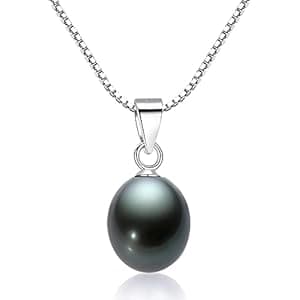 B0981Y1BGR Price: $39.99 Score: 9.524 Category: Clothing Rating: 4.4 Votes: 3 Find similar productsHEAICHEN Pearl Necklace for Women Girls in Sterling Sliver 7-8mm Genuine Black Tahitian South Sea Cultured Pearl with 18 Chain. What is a Tahiti black pearl The Tahitian black pearl is found in the coral atolls of French Polynesia in the South Pacific. Mother-of-pearl is a black butterfly shell that secretes black nacre. The beauty of black pearl lies in that it has a variety of colorful colors on the black tone of the sky. The most appreciated colors are peacock green, thick purple, sea blue and other rainbow colors. Her strong metallic luster changes with the rotation of the pearl, which is far from that of other modified pearls. Black pearls generally have a diameter of 8 to 16 millimeters. They range from round to pear-shaped and even looped. Why choose Tahiti Black Pearl Tahitian pearl necklaces are real pearls, thick and rainbow pearls. It's gorgeous and glamorous, and when you wear it, it's definitely the focus of the crowd. Packaging Jewelry box * 1 Pearl Necklace * 1 Perfect gift fit for any occasion A perfect gift for lovers, yourself, women, men, wife, girlfriend, boyfriend, daughter, or friends on Valentine's Day, Mother's Day, Father's Day, Christmas Day, New Year, Anniversary, Wedding, Birthday, Parties. |
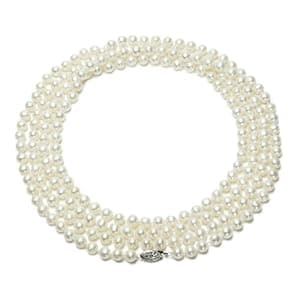 B001VNB7IO Availability: Currently unavailable Score: 9.174 Category: Clothing Rating: 5 Votes: 2 Find similar productsSterling Silver Freshwater Cultured Pearl A Grade 6.5-7mm Necklace, 60. A radiant pearl necklace puts a classy finish on any outfit. This long and lavish 60-inch strand showcases freshwater cultured pearls, in your choice of chocolate brown, silvery black, rosy pink, mixed pastel, or traditional white. The 6.5-7mm freshwater cultured pearls are hand-knotted on silk cord, and the necklace is finished with a sterling silver filigree fishhook clasp. With its generous length, this necklace is easily wrapped for a layered look. The Amazon Curated Collection Discover the Amazon Curated Collection of fine and fashion jewelry. The expansive selection of high-quality jewelry featured in the Amazon Curated Collection offers everyday values that range from precious gemstone and diamond pieces to the latest fashion designs. This hand-selected assortment features an array of diamond, gemstone, and precious metal designs that receive a quality inspection, including from Amazon’s staff graduate gemologist, to ensure they meet Amazon’s high standards. All diamonds featured in the Amazon Curated Collection are certified by our suppliers to be conflict free, and IGI, GIA, or AGS certifications are provided on white diamonds of .75 carats or larger on all stud earrings, rings, and pendant necklaces. Pieces from the Amazon Curated Collection come packaged in a custom box, making them wonderful gifts. In addition, we offer free one-day shipping within the continental U.S. on items over $500. International shipping options for friends and family overseas are available for an additional fee. The Amazon Curated Collection offers a specialized customer service team that is available seven days a week to answer any product questions before, during or after the purchase. If you’re not satisfied for any reason, you will receive a full refund and free return shipping within the U.S. if you return your purchase within 30 days. Find a special gift for a loved one or a beautiful piece that complements your personal style with jewelry from the Amazon Curated Collection. Freshwater Cultured Pearls These pearls are gathered from freshwater lake and river mollusks. Most Freshwater pearls come from China and they can be mostly round to off-round, or rice-shaped to baroque. They look similar to Akoya pearls, but are the perfect gift when on a budget. They might be slightly less symmetrical, smaller, or not as easily matched, but these minor differences provide a major value for the price. Cultivation Pearls are produced naturally in the body of salt and freshwater mollusks, such as oysters and mussels. When these animals sense an irritant, such as a grain of sand, they produce a soft coating of calcium carbonate substance around it. The result is a pearl. Because perfectly round, naturally produced pearls are so rare, a process known as cultivation was developed by Kokichi Mikimoto in the early 1900s. A small bead of polished shell, the nucleus, is used as an irritant and delicately inserted into the mantle of a mollusk. It takes approximately 20-24 months of intensive husbandry to cultivate a saltwater pearl and somewhat less time to cultivate freshwater pearls. The harvest usually takes place during the months of June and September. Color Mollusks produce pearls in a variety of colors, accommodating most personal preferences and budgets. The general color of a pearl is also known as the body color. Pearls typically range from white, cream, and yellow to pink, silver, or black. An overtone of secondary color is sometimes seen. For instance, a pearl may appear to be white, but upon closer inspection a rosy hue is detected. The body color would then be termed white-rosé. Color variation does not affect the quality of the pearl, though it should be noted that color matching is important when choosing pearls for some necklaces, earrings, or bracelets. In fashion jewelry, pearls can sometimes be dyed to achieve the desired color, which should be mentioned in the product description or specifications. Lustre The appealing, deep shine of a pearl is often what defines its beauty. This shine is produced by multiple layers of semi-opaque calcium carbonate crystals, called nacre. The nacre reflects light on the surface of the pearl, producing brilliance and sheen. Lustre is an integral feature in determining the quality of a pearl. Large pearls have a thicker nacre and, therefore, a higher lustre. When comparing a small Freshwater pearl to a large South Sea pearl, the difference is clearly visible to the untrained eye and should be considered when purchasing pearls. Shape While pearls come in many different shapes, the rarest and highest-quality are round. Akoya, Tahitian, and South Sea oysters tend to produce the roundest pearls, while those of Freshwater mollusks can be oval to slightly off-round. When considering a pearl purchase, whether it be a necklace, bracelet, or earrings, look for consistency in the shapes of the pearls. Many of the less symmetrical shapes are used in stylish jewelry which can be quite beautiful: the drop pearl's shape lends well to earrings, and the baroque pearl features irregular shapes that work well as necklace accents. In addition, a half sphere pearl called a mabe is often used in earrings, necklaces, and bracelets. Size An oyster's particular type and size has a direct effect on how large the pearl it produces will be, and pearls do come in a wide range of sizes. Round pearls are measured according to their diameter, while baroque pearls are measured by their length and width. A pearl's size does not necessarily affect its quality, but it does affect its price. Large, round pearls are rare and their lustre is usually high--this beautiful combination of traits is often reflected in the cost of such pearls. Average pearl sizes (in diameter): Akoya: 6-8mm Freshwater: 5-6.5mm South Sea: 11-13mm Tahitian: 11-12mm Keshi: 4-10mm Surface Markings Often when an oyster creates a pearl, the nacre does not develop smoothly. The surface of a pearl is judged by how many marks are visible in the nacre. These imperfections can be small and unnoticeable or quite large and distinct. Like diamonds, pearls are rarely flawless. However, high lustre or the way pearls are strung and set can help conceal surface markings. Care Proper care of pearls is not difficult if you remember that they are organic and produced by a living thing. Pearls are soft and delicate, but when cared for with common sense, they will maintain their lustre for centuries. The pearls should not come in contact with cosmetics, hairspray, perfume, chlorinated water, or other harsh chemicals. To keep them clean, let them be the last item put on when dressing, and the first item taken off at the end of an evening. The best way to maintain their lustre is to wear the pearls often, and wipe them down with a soft cloth afterward--pearls absorb the oils from skin, which helps keep them moist. Pearls should be stored in a cloth pouch or jewelry bag, separated from other jewelry to prevent nicks or chipping. Periodically, pearl strands should be restrung since the silk thread used to tie the pearls together breaks down over time. | 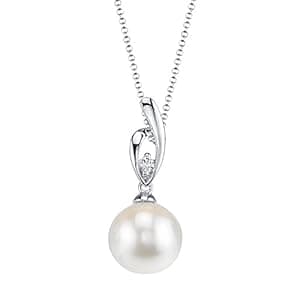 B01GF0A1XE Price: $339 Score: 8.696 Category: Clothing Rating: 4.6 Votes: 89 Find similar productsFreshwater Cultured Pearl Pendant for Women Pearl and Diamond Pendant Necklace with 14K Gold - THE PEARL SOURCE. . |
 B01N9SU2RG Availability: Currently unavailable Score: 8.696 Category: Clothing Rating: 2.5 Votes: 6 Find similar productsPalmBeach Jewelry Silvertone Cameo Genuine Peacock Mother of Pearl and Cultured Freshwater Pearl Multi Strand Necklace (23mm), 28 inches. . |  B005VFGI0A Availability: Currently unavailable Score: 8.621 Category: Clothing Rating: 5 Votes: 2 Find similar productsAmazon Collection Sterling Silver Bow Cubic Zirconia Diamond Cut Freshwater Cultured Pearl Necklace, 16+2 Extender. Like a stunning gift all tied up in a bow, the Sterling Silver Bow Cubic Zirconia Diamond Cut Freshwater Pearl Necklace is a true symbol of romance. Displayed at the base of a 16-inch rolo chain is an adorable open bow shape that is completely embellished in pave-set cubic zirconia stones. The center of the pendant is touched with a semi-round freshwater pearl that reveals a medium luster and good uniformity. A lobster-claw clasp allows the pendant to easily adjust up to two inches. The Amazon Curated Collection Discover the Amazon Curated Collection of fine and fashion jewelry. The expansive selection of high-quality jewelry featured in the Amazon Curated Collection offers everyday values that range from precious gemstone and diamond pieces to the latest fashion designs. This hand-selected assortment features an array of diamond, gemstone, and precious metal designs that receive a quality inspection, including from Amazon’s staff graduate gemologist, to ensure they meet Amazon’s high standards. All diamonds featured in the Amazon Curated Collection are certified by our suppliers to be conflict free, and IGI, GIA, or AGS certifications are provided on white diamonds of .75 carats or larger on all stud earrings, rings, and pendant necklaces. Pieces from the Amazon Curated Collection come packaged in a custom box, making them wonderful gifts. In addition, we offer free one-day shipping within the continental U.S. on items over $500. International shipping options for friends and family overseas are available for an additional fee. The Amazon Curated Collection offers a specialized customer service team that is available seven days a week to answer any product questions before, during or after the purchase. If you’re not satisfied for any reason, you will receive a full refund and free return shipping within the U.S. if you return your purchase within 30 days. Find a special gift for a loved one or a beautiful piece that complements your personal style with jewelry from the Amazon Curated Collection. Cubic Zirconia History In 1937, Cubic Zirconia was first discovered by German mineralogists, M. V. Stackelberg and K. Chudoba. Little did they know, the tiny crystals that they discovered would move on to become a popular synthetic gemstone. It wasn’t until the 1970s that Cubic Zirconia was first used in the jewelry world, when scientists began growing the crystals in the laboratory. In the 1980s, Cubic Zirconia use in jewelry continued to grow and today is it one of the most popular diamond substitutes available on the market. Composition Cubic Zirconia is the cubic form of zirconium oxide that is created in a laboratory. Its durable material allows the synthetic stone to be molded into a variety of shapes. The stone offers brilliant shine and flawless clarity. Cubic Zirconia is available in a wide range of colors, including a colorless form that is an economically important competitor to natural diamonds. Caring For Your Cubic Zirconia Jewelry Like natural diamonds, Cubic Zirconia needs to be cared for in order to maintain its original brilliance and shine. Clean with warm-to-hot water and a soft brush with a mild soap, then immediately dry with a clean cloth after rinsing. Avoid contact with perfume, body lotion, hairspray or any other chemical that may harm the shine of the stone. Freshwater Cultured Pearls These pearls are gathered from freshwater lake and river mollusks. Most Freshwater pearls come from China and they can be mostly round to off-round, or rice-shaped to baroque. They look similar to Akoya pearls, but are the perfect gift when on a budget. They might be slightly less symmetrical, smaller, or not as easily matched, but these minor differences provide a major value for the price. Cultivation Pearls are produced naturally in the body of salt and freshwater mollusks, such as oysters and mussels. When these animals sense an irritant, such as a grain of sand, they produce a soft coating of calcium carbonate substance around it. The result is a pearl. Because perfectly round, naturally produced pearls are so rare, a process known as cultivation was developed by Kokichi Mikimoto in the early 1900s. A small bead of polished shell, the nucleus, is used as an irritant and delicately inserted into the mantle of a mollusk. It takes approximately 20-24 months of intensive husbandry to cultivate a saltwater pearl and somewhat less time to cultivate freshwater pearls. The harvest usually takes place during the months of June and September. Color Mollusks produce pearls in a variety of colors, accommodating most personal preferences and budgets. The general color of a pearl is also known as the body color. Pearls typically range from white, cream, and yellow to pink, silver, or black. An overtone of secondary color is sometimes seen. For instance, a pearl may appear to be white, but upon closer inspection a rosy hue is detected. The body color would then be termed white-rosé. Color variation does not affect the quality of the pearl, though it should be noted that color matching is important when choosing pearls for some necklaces, earrings, or bracelets. In fashion jewelry, pearls can sometimes be dyed to achieve the desired color, which should be mentioned in the product description or specifications. Lustre The appealing, deep shine of a pearl is often what defines its beauty. This shine is produced by multiple layers of semi-opaque calcium carbonate crystals, called nacre. The nacre reflects light on the surface of the pearl, producing brilliance and sheen. Lustre is an integral feature in determining the quality of a pearl. Large pearls have a thicker nacre and, therefore, a higher lustre. When comparing a small Freshwater pearl to a large South Sea pearl, the difference is clearly visible to the untrained eye and should be considered when purchasing pearls. Shape While pearls come in many different shapes, the rarest and highest-quality are round. Akoya, Tahitian, and South Sea oysters tend to produce the roundest pearls, while those of Freshwater mollusks can be oval to slightly off-round. When considering a pearl purchase, whether it be a necklace, bracelet, or earrings, look for consistency in the shapes of the pearls. Many of the less symmetrical shapes are used in stylish jewelry which can be quite beautiful: the drop pearl's shape lends well to earrings, and the baroque pearl features irregular shapes that work well as necklace accents. In addition, a half sphere pearl called a mabe is often used in earrings, necklaces, and bracelets. Size An oyster's particular type and size has a direct effect on how large the pearl it produces will be, and pearls do come in a wide range of sizes. Round pearls are measured according to their diameter, while baroque pearls are measured by their length and width. A pearl's size does not necessarily affect its quality, but it does affect its price. Large, round pearls are rare and their lustre is usually high--this beautiful combination of traits is often reflected in the cost of such pearls. Average pearl sizes (in diameter): Akoya: 6-8mm Freshwater: 5-6.5mm South Sea: 11-13mm Tahitian: 11-12mm Keshi: 4-10mm Surface Markings Often when an oyster creates a pearl, the nacre does not develop smoothly. The surface of a pearl is judged by how many marks are visible in the nacre. These imperfections can be small and unnoticeable or quite large and distinct. Like diamonds, pearls are rarely flawless. However, high lustre or the way pearls are strung and set can help conceal surface markings. Care Proper care of pearls is not difficult if you remember that they are organic and produced by a living thing. Pearls are soft and delicate, but when cared for with common sense, they will maintain their lustre for centuries. The pearls should not come in contact with cosmetics, hairspray, perfume, chlorinated water, or other harsh chemicals. To keep them clean, let them be the last item put on when dressing, and the first item taken off at the end of an evening. The best way to maintain their lustre is to wear the pearls often, and wipe them down with a soft cloth afterward--pearls absorb the oils from skin, which helps keep them moist. Pearls should be stored in a cloth pouch or jewelry bag, separated from other jewelry to prevent nicks or chipping. Periodically, pearl strands should be restrung since the silk thread used to tie the pearls together breaks down over time. |
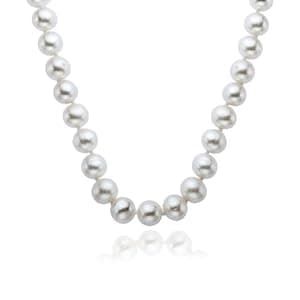 B005LW0ANO Availability: Currently unavailable Score: 8.475 Category: Clothing Rating: 2.3 Votes: 8 Find similar productsAmazon Collection White Freshwater Cultured Pearl Strand with Sterling Silver Clasp (6mm), 18. Capture the traditional elegance of white freshwater pearls when donning the White Freshwater Cultured Pearl Strand with Sterling Silver Clasp. This 18-inch necklace features classic 6-6.5mm potato-shaped pearls, showcasing a medium luster and good uniformity. Single knots are placed in between each pearl which protects the surface, or nacre of the white beauties. A wonderful gift for all occasions, this necklace will add a polished look to any outfit for years to come. The Amazon Curated Collection Discover the Amazon Curated Collection of fine and fashion jewelry. The expansive selection of high-quality jewelry featured in the Amazon Curated Collection offers everyday values that range from precious gemstone and diamond pieces to the latest fashion designs. This hand-selected assortment features an array of diamond, gemstone, and precious metal designs that receive a quality inspection, including from Amazon’s staff graduate gemologist, to ensure they meet Amazon’s high standards. All diamonds featured in the Amazon Curated Collection are certified by our suppliers to be conflict free, and IGI, GIA, or AGS certifications are provided on white diamonds of .75 carats or larger on all stud earrings, rings, and pendant necklaces. Pieces from the Amazon Curated Collection come packaged in a custom box, making them wonderful gifts. In addition, we offer free one-day shipping within the continental U.S. on items over $500. International shipping options for friends and family overseas are available for an additional fee. The Amazon Curated Collection offers a specialized customer service team that is available seven days a week to answer any product questions before, during or after the purchase. If you’re not satisfied for any reason, you will receive a full refund and free return shipping within the U.S. if you return your purchase within 30 days. Find a special gift for a loved one or a beautiful piece that complements your personal style with jewelry from the Amazon Curated Collection. Freshwater Cultured Pearls These pearls are gathered from freshwater lake and river mollusks. Most Freshwater pearls come from China and they can be mostly round to off-round, or rice-shaped to baroque. They look similar to Akoya pearls, but are the perfect gift when on a budget. They might be slightly less symmetrical, smaller, or not as easily matched, but these minor differences provide a major value for the price. Cultivation Pearls are produced naturally in the body of salt and freshwater mollusks, such as oysters and mussels. When these animals sense an irritant, such as a grain of sand, they produce a soft coating of calcium carbonate substance around it. The result is a pearl. Because perfectly round, naturally produced pearls are so rare, a process known as cultivation was developed by Kokichi Mikimoto in the early 1900s. A small bead of polished shell, the nucleus, is used as an irritant and delicately inserted into the mantle of a mollusk. It takes approximately 20-24 months of intensive husbandry to cultivate a saltwater pearl and somewhat less time to cultivate freshwater pearls. The harvest usually takes place during the months of June and September. Color Mollusks produce pearls in a variety of colors, accommodating most personal preferences and budgets. The general color of a pearl is also known as the body color. Pearls typically range from white, cream, and yellow to pink, silver, or black. An overtone of secondary color is sometimes seen. For instance, a pearl may appear to be white, but upon closer inspection a rosy hue is detected. The body color would then be termed white-rosé. Color variation does not affect the quality of the pearl, though it should be noted that color matching is important when choosing pearls for some necklaces, earrings, or bracelets. In fashion jewelry, pearls can sometimes be dyed to achieve the desired color, which should be mentioned in the product description or specifications. Lustre The appealing, deep shine of a pearl is often what defines its beauty. This shine is produced by multiple layers of semi-opaque calcium carbonate crystals, called nacre. The nacre reflects light on the surface of the pearl, producing brilliance and sheen. Lustre is an integral feature in determining the quality of a pearl. Large pearls have a thicker nacre and, therefore, a higher lustre. When comparing a small Freshwater pearl to a large South Sea pearl, the difference is clearly visible to the untrained eye and should be considered when purchasing pearls. Shape While pearls come in many different shapes, the rarest and highest-quality are round. Akoya, Tahitian, and South Sea oysters tend to produce the roundest pearls, while those of Freshwater mollusks can be oval to slightly off-round. When considering a pearl purchase, whether it be a necklace, bracelet, or earrings, look for consistency in the shapes of the pearls. Many of the less symmetrical shapes are used in stylish jewelry which can be quite beautiful: the drop pearl's shape lends well to earrings, and the baroque pearl features irregular shapes that work well as necklace accents. In addition, a half sphere pearl called a mabe is often used in earrings, necklaces, and bracelets. Size An oyster's particular type and size has a direct effect on how large the pearl it produces will be, and pearls do come in a wide range of sizes. Round pearls are measured according to their diameter, while baroque pearls are measured by their length and width. A pearl's size does not necessarily affect its quality, but it does affect its price. Large, round pearls are rare and their lustre is usually high--this beautiful combination of traits is often reflected in the cost of such pearls. Average pearl sizes (in diameter): Akoya: 6-8mm Freshwater: 5-6.5mm South Sea: 11-13mm Tahitian: 11-12mm Keshi: 4-10mm Surface Markings Often when an oyster creates a pearl, the nacre does not develop smoothly. The surface of a pearl is judged by how many marks are visible in the nacre. These imperfections can be small and unnoticeable or quite large and distinct. Like diamonds, pearls are rarely flawless. However, high lustre or the way pearls are strung and set can help conceal surface markings. Care Proper care of pearls is not difficult if you remember that they are organic and produced by a living thing. Pearls are soft and delicate, but when cared for with common sense, they will maintain their lustre for centuries. The pearls should not come in contact with cosmetics, hairspray, perfume, chlorinated water, or other harsh chemicals. To keep them clean, let them be the last item put on when dressing, and the first item taken off at the end of an evening. The best way to maintain their lustre is to wear the pearls often, and wipe them down with a soft cloth afterward--pearls absorb the oils from skin, which helps keep them moist. Pearls should be stored in a cloth pouch or jewelry bag, separated from other jewelry to prevent nicks or chipping. Periodically, pearl strands should be restrung since the silk thread used to tie the pearls together breaks down over time. |  B00LIBJIP8 Price: $79 Score: 8.475 Category: Clothing Rating: 4.1 Votes: 8 Find similar productsTHE PEARL SOURCE 8-9mm Genuine White Freshwater Cultured Pearl & Cubic Zirconia Double Pendant Necklace for Women. This beautiful pearl pendant would be the perfect gift for any occasion. The pendant features 2 AAA Quality, 8mm White Freshwater pearls, and is mounted with two dazzling crystals on the finest 925 sterling silver. The pendant is suspended on a 17 inch sterling silver chain. All products come packaged in a beautiful jewelry box with a genuine cultured pearl guarantee. |