E-commerce Search Demo
AI Assisted Filters
Parameters
Query:
Category filters: All
AI Assist: ON
Page: 1
Products
Time taken: 3 Max score: 1000.000 Total hits: 200 Full time: 0.0 s
Showing 1-10 of 200 products
 B00GR0GGVY Availability: Currently unavailable Score: 1000.000 Category: Sports Rating: 4.1 Votes: 48 Find similar productsEureka Midori Solo. Eureka Midori Solo Tent - 1 Person, 3 Season. |  B002PUNGKY Availability: Currently unavailable Score: 6.711 Category: Sports Rating: 2 Votes: 1 Find similar productsChinook Tradewinds Guide Aluminum Tent - 6 Person. . |
 B00IFERHSG Availability: Currently unavailable Score: 6.623 Category: Sports Rating: 4 Votes: 4 Find similar productsBig Agnes Seedhouse SL 3-3 Person Tent. . |  B0015LJWEI Availability: Currently unavailable Score: 6.536 Category: Sports Rating: 1 Votes: 1 Find similar productsBig Agnes Seedhouse Footprint - 1 Person. Three season, free standing, superlight backpacking tent To extend the life of your tent floor, we recommend using a Big Agnes footprint or ground cloth. The Big Agnes footprint also enables you to pitch a lightweight, Fast Fly shelter while leaving the tent body behind. The Fast Fly configuration requires the footprint, tent fly, poles, and stakes. |
 B016OEDV5Q Availability: Currently unavailable Score: 6.452 Category: Sports Rating: 4.4 Votes: 127 Find similar productsGrand Canyon Waterproof Indiana Unisex Outdoor Pyramid Tent. Grand Canyon Indiana The Tepee from Grand Canyon is the perfect tent for small and big adventures or just for a relaxing camping holiday. The pitching is quick and easy. Comfortable are also the big entrance and headroom. Details: Person: up to 8 Person Size Outer Tent: 400 x 400 x 250 cm Weight: 9,9 Kg Packing Size: 77 x 26 cm Material Outer Tent: Polyester Material Floor: Polyethylen Hydrosatic Head: 3000 mm Poles: Glasfiber Pegs: Steel Grand Canyon tents are characterised by high quality fabrics, careful processing and high functionality. The range stretches from beach and garden tents to trekking tents and comfortable and spacious camping tents for family holidays. All at a fair and affordable price/quality level. Grand Canyon is member of the BSCI (Business Social Compliance Initiative), whose goal is to improve the social benefits and responsibilities of suppliers continuously. The BSCI Code of Conduct is based on internationally recognized standards and protects according to the SA8000, inter alia the interests and rights of workers around the world. | 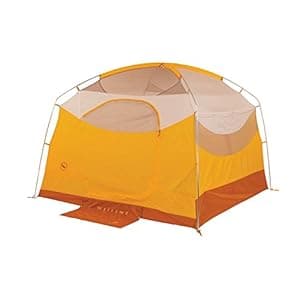 B01IOZSXRO Availability: Currently unavailable Score: 6.410 Category: Sports Rating: 4.5 Votes: 23 Find similar productsBig Agnes Big House Deluxe Camping Tent. . |
 B0BMV1S36F Availability: Currently unavailable Score: 6.329 Category: Sports Rating: 5 Votes: 2 Find similar productsSTARBRILLIANT Camping Tent for 4-6 Person Family Tent (4 People). . |  B007AF0G0C Availability: Currently unavailable Score: 6.250 Category: Sports Rating: 4 Votes: 1 Find similar productsMountain Hardwear Yurtini™ Tent. Yurts are one of the oldest housing structures, and possibly the most efficient. Based on the classic yurt design, the Yurtini's round shape allows 208 square feet of floor space, enough room for six people to sleep comfortably. |
 B01IOXB5BC Availability: Currently unavailable Score: 6.135 Category: Sports Rating: 4.2 Votes: 8 Find similar productsBig Agnes 2019 Copper Spur HV UL1 Backpacking Tent, Gray/Orange, 1 Person. . |  B001145LY4 Availability: Currently unavailable Score: 6.135 Category: Sports Rating: 4.2 Votes: 25 Find similar productsEureka! Spitfire 2 - Tent (sleeps 2). Product Description Original Spitfire styling in a 2 person model! Loaded with mesh for great ventilation, and ample-sized headroom area that's as large or larger than the competition's! Amazon.com The original Eureka SpitFire gets expanded to comfortably fit two sleepers with the two-pole Spitfire 2 hoop tent. It features more headroom than most tents in its class, making it very easy and comfortable to sit up in. It's also extremely well ventilated with large mesh panels--great for stargazing during summer trips. It has a large side door that makes it easy to get in and out of the tent. The bathtub floor keeps seams taut and high off the ground for superior protection. The full coverage fly features a poke-out vent that's closable and accessible from inside the tent. Side release buckles attach the fly to body for fast easy set up. Only two stakes are required to secure the tent's body, and post and grommet corner attachments make set up easy. Other features include: 4 storm guyouts on fly 4 storm guyouts on fly 9 mm DAC Featherlite 7000 series aluminum frame 9 mm DAC Featherlite 7000 series aluminum frame Inside storage pocket holds essentials Inside storage pocket holds essentials Flashlight loop Flashlight loop Tent, pole and stake bags included. Specifications:Area: 38.75 square feet Floor size: 10 feet, 9 inches by 5 feet, 10 inches by 4 feet, 4.5 inches Center height: 3 feet, 7 inches Wall fabrics: 1.9-ounce 70D nylon taffeta w/1200mm coating Floor fabrics: 1.9-ounce 70D nylon taffeta w/1200mm coating Fly fabrics: 75D Stormshield polyester Pack size: 5 by 17 inches Weight: 4 pounds About Eureka Though the exact year is unknown, Eurekas long history begins prior to 1895 in Binghamton, New York, where the company still resides today. Then known as the Eureka Tent & Awning Company, its first wares were canvas products--most notably, Conestoga wagon covers and horse blankets for nineteenth century American frontiersmen--as well as American flags, store awnings, and camping tents. The company increased production of its custom canvas products locally throughout the 1930s and during the 1940 and even fabricated and erected the IBM tent cities just outside Binghamton. The seven acres of tents housed thousands of IBM salesmen during the companys annual stockholders meeting, which had since outgrown its previous locale. In the 1940s, with the advent of World War II and the increased demand for hospital ward tents, Eureka expanded operations and began shipping tents worldwide. Ultimately, upon the post-war return of the GIs and the resultant housing shortage, Eureka turned its attention to the home front during the 1950s by supplying awnings for the multitude of mobile homes that were purchased. In 1960, Eurekas new and innovative Draw-Tite tent, with its practical, free standing external frame, was used in a Himalayan Expedition to Nepal by world renowned Sir Edmund Hillary, the first person documented to summit Mt. Everest only six years earlier. In 1963, Eureka made history during its own Mt. Everest ascent, with more than 60 of its tents sheltering participants from fierce 60+ mph winds and temperatures reaching below -20°F during the first all American Mt. Everest Expedition. For backpackers and families, Eureka introduced its legendary Timberline tent in the 1970s. Truly the first StormShield design, this completely self-supporting and lightweight backpacking tent became one of the most popular tents the entire industry with sales reaching over 1 million by its ten year anniversary. Eureka tents have also traveled as part of several historic expeditions, including the American Womens Himalayan Expedition to Annapurna I in 1978 and the first Mt. Everest ascents by a Canadian and American woman in 1986 and 1988. In recent history, tents specially designed and donated by Eureka sheltered Eric Simonson and his team on two historic research expeditions to Mount Everest, this time in a quest for truth regarding the 1924 attempted summit of early English explorers George Mallory and Andrew Irvine. During the 1999 expedition, the team made history finding the remains of George Mallory, but the complete mystery remained unsolved. Returning in 2001 to search for more clues, the team found amazing historical artifacts which are now on display at the Smithsonian.Amazon.com Tent Guide Selecting a Tent Fortunately, there are all kinds of tents for weekend car campers, Everest expeditions, and everything in-between. Here are a few things to keep in mind:Expect the Worst In general, it's wise to choose a tent that's designed to withstand the worst possible conditions you think you'll face. For instance, if you're a summer car camper in a region where weather is predictable, an inexpensive family or all purpose tent will likely do the trick--especially if a vehicle is nearby and you can make a mad dash for safety when bad weather swoops in! If you're a backpacker, alpine climber or bike explorer, or if you like to car camp in all seasons, you'll want to take something designed to handle more adversity.Three- and Four-Season Tents For summer, early fall and late spring outings, choose a three-season tent. At minimum, a quality three season tent will have lightweight aluminum poles, a reinforced floor, durable stitching, and a quality rain-fly. Some three-season tents offer more open-air netting and are more specifically designed for summer backpacking and other activities. Many premium tents will feature pre-sealed, taped seams and a silicone-impregnated rain-fly for enhanced waterproofness. For winter camping or alpine travel, go with a four season model. Because they typically feature more durable fabric coatings, as well as more poles, four-season tents are designed to handle heavy snowfall and high winds without collapsing. Of course, four-season tents exact a weight penalty of about 10 to 20 percent in trade for their strength and durability. They also tend to be more expensive.Domes and Tunnels Tents are broadly categorized into two types, freestanding, which can stand up on their own, and those that must be staked down in order to stand upright. Freestanding tents often incorporate a dome-shaped design, and most four-season tents are constructed this way because a dome leaves no flat spots on the outer surface where snow can collect. Domes are also inherently stronger than any other design. Meanwhile, many three-season models employ a modified dome configuration called a tunnel. These are still freestanding, but they require fewer poles than a dome, use less fabric, and typically have a rectangular floor-plan that offers less storage space than a dome configuration. Many one and two-person tents are not freestanding, but they make up for it by being more lightweight. Because they use fewer poles, they can also be quicker to set up than a dome.Size Matters Ask yourself how many people you'd like to fit in your fabric hotel now and in the future. For soloists and minimalists, check out one-person tents. If you're a mega-minimalist, or if you have your eye on doing some big wall climbs, a waterproof-breathable bivy sack is the ticket. Some bivy sacks feature poles and stake points to give you a little more breathing room. Also, if you don't need bug protection and you want to save weight, check out open-air shelters. Families who plan on car camping in good weather can choose from a wide range of jumbo-sized tents that will accommodate all your little ones with room to spare. A wide range of capacities is also available for three- and four-season backpacking and expedition tents. Remember, though, the bigger the tent you buy, the heavier it will be, although it's easy to break up the tent components among several people in your group. It's also helpful to compare the volume and floor-space measurements of models you're considering. Tent, pole and stake bags included. Specifications: Area: 38.75 square feet Area: 38.75 square feet Floor size: 10 feet, 9 inches by 5 feet, 10 inches by 4 feet, 4.5 inches Floor size: 10 feet, 9 inches by 5 feet, 10 inches by 4 feet, 4.5 inches Center height: 3 feet, 7 inches Center height: 3 feet, 7 inches Wall fabrics: 1.9-ounce 70D nylon taffeta w/1200mm coating Wall fabrics: 1.9-ounce 70D nylon taffeta w/1200mm coating Floor fabrics: 1.9-ounce 70D nylon taffeta w/1200mm coating Floor fabrics: 1.9-ounce 70D nylon taffeta w/1200mm coating Fly fabrics: 75D Stormshield polyester Fly fabrics: 75D Stormshield polyester Pack size: 5 by 17 inches Pack size: 5 by 17 inches Weight: 4 pounds About Eureka Though the exact year is unknown, Eurekas long history begins prior to 1895 in Binghamton, New York, where the company still resides today. Then known as the Eureka Tent & Awning Company, its first wares were canvas products--most notably, Conestoga wagon covers and horse blankets for nineteenth century American frontiersmen--as well as American flags, store awnings, and camping tents. The company increased production of its custom canvas products locally throughout the 1930s and during the 1940 and even fabricated and erected the IBM tent cities just outside Binghamton. The seven acres of tents housed thousands of IBM salesmen during the companys annual stockholders meeting, which had since outgrown its previous locale. In the 1940s, with the advent of World War II and the increased demand for hospital ward tents, Eureka expanded operations and began shipping tents worldwide. Ultimately, upon the post-war return of the GIs and the resultant housing shortage, Eureka turned its attention to the home front during the 1950s by supplying awnings for the multitude of mobile homes that were purchased. In 1960, Eurekas new and innovative Draw-Tite tent, with its practical, free standing external frame, was used in a Himalayan Expedition to Nepal by world renowned Sir Edmund Hillary, the first person documented to summit Mt. Everest only six years earlier. In 1963, Eureka made history during its own Mt. Everest ascent, with more than 60 of its tents sheltering participants from fierce 60+ mph winds and temperatures reaching below -20°F during the first all American Mt. Everest Expedition. For backpackers and families, Eureka introduced its legendary Timberline tent in the 1970s. Truly the first StormShield design, this completely self-supporting and lightweight backpacking tent became one of the most popular tents the entire industry with sales reaching over 1 million by its ten year anniversary. Eureka tents have also traveled as part of several historic expeditions, including the American Womens Himalayan Expedition to Annapurna I in 1978 and the first Mt. Everest ascents by a Canadian and American woman in 1986 and 1988. In recent history, tents specially designed and donated by Eureka sheltered Eric Simonson and his team on two historic research expeditions to Mount Everest, this time in a quest for truth regarding the 1924 attempted summit of early English explorers George Mallory and Andrew Irvine. During the 1999 expedition, the team made history finding the remains of George Mallory, but the complete mystery remained unsolved. Returning in 2001 to search for more clues, the team found amazing historical artifacts which are now on display at the Smithsonian.Amazon.com Tent Guide Selecting a Tent Fortunately, there are all kinds of tents for weekend car campers, Everest expeditions, and everything in-between. Here are a few things to keep in mind:Expect the Worst In general, it's wise to choose a tent that's designed to withstand the worst possible conditions you think you'll face. For instance, if you're a summer car camper in a region where weather is predictable, an inexpensive family or all purpose tent will likely do the trick--especially if a vehicle is nearby and you can make a mad dash for safety when bad weather swoops in! If you're a backpacker, alpine climber or bike explorer, or if you like to car camp in all seasons, you'll want to take something designed to handle more adversity.Three- and Four-Season Tents For summer, early fall and late spring outings, choose a three-season tent. At minimum, a quality three season tent will have lightweight aluminum poles, a reinforced floor, durable stitching, and a quality rain-fly. Some three-season tents offer more open-air netting and are more specifically designed for summer backpacking and other activities. Many premium tents will feature pre-sealed, taped seams and a silicone-impregnated rain-fly for enhanced waterproofness. For winter camping or alpine travel, go with a four season model. Because they typically feature more durable fabric coatings, as well as more poles, four-season tents are designed to handle heavy snowfall and high winds without collapsing. Of course, four-season tents exact a weight penalty of about 10 to 20 percent in trade for their strength and durability. They also tend to be more expensive.Domes and Tunnels Tents are broadly categorized into two types, freestanding, which can stand up on their own, and those that must be staked down in order to stand upright. Freestanding tents often incorporate a dome-shaped design, and most four-season tents are constructed this way because a dome leaves no flat spots on the outer surface where snow can collect. Domes are also inherently stronger than any other design. Meanwhile, many three-season models employ a modified dome configuration called a tunnel. These are still freestanding, but they require fewer poles than a dome, use less fabric, and typically have a rectangular floor-plan that offers less storage space than a dome configuration. Many one and two-person tents are not freestanding, but they make up for it by being more lightweight. Because they use fewer poles, they can also be quicker to set up than a dome.Size Matters Ask yourself how many people you'd like to fit in your fabric hotel now and in the future. For soloists and minimalists, check out one-person tents. If you're a mega-minimalist, or if you have your eye on doing some big wall climbs, a waterproof-breathable bivy sack is the ticket. Some bivy sacks feature poles and stake points to give you a little more breathing room. Also, if you don't need bug protection and you want to save weight, check out open-air shelters. Families who plan on car camping in good weather can choose from a wide range of jumbo-sized tents that will accommodate all your little ones with room to spare. A wide range of capacities is also available for three- and four-season backpacking and expedition tents. Remember, though, the bigger the tent you buy, the heavier it will be, although it's easy to break up the tent components among several people in your group. It's also helpful to compare the volume and floor-space measurements of models you're considering. Weight: 4 pounds About Eureka Though the exact year is unknown, Eurekas long history begins prior to 1895 in Binghamton, New York, where the company still resides today. Then known as the Eureka Tent & Awning Company, its first wares were canvas products--most notably, Conestoga wagon covers and horse blankets for nineteenth century American frontiersmen--as well as American flags, store awnings, and camping tents. The company increased production of its custom canvas products locally throughout the 1930s and during the 1940 and even fabricated and erected the IBM tent cities just outside Binghamton. The seven acres of tents housed thousands of IBM salesmen during the companys annual stockholders meeting, which had since outgrown its previous locale. In the 1940s, with the advent of World War II and the increased demand for hospital ward tents, Eureka expanded operations and began shipping tents worldwide. Ultimately, upon the post-war return of the GIs and the resultant housing shortage, Eureka turned its attention to the home front during the 1950s by supplying awnings for the multitude of mobile homes that were purchased. In 1960, Eurekas new and innovative Draw-Tite tent, with its practical, free standing external frame, was used in a Himalayan Expedition to Nepal by world renowned Sir Edmund Hillary, the first person documented to summit Mt. Everest only six years earlier. In 1963, Eureka made history during its own Mt. Everest ascent, with more than 60 of its tents sheltering participants from fierce 60+ mph winds and temperatures reaching below -20°F during the first all American Mt. Everest Expedition. For backpackers and families, Eureka introduced its legendary Timberline tent in the 1970s. Truly the first StormShield design, this completely self-supporting and lightweight backpacking tent became one of the most popular tents the entire industry with sales reaching over 1 million by its ten year anniversary. Eureka tents have also traveled as part of several historic expeditions, including the American Womens Himalayan Expedition to Annapurna I in 1978 and the first Mt. Everest ascents by a Canadian and American woman in 1986 and 1988. In recent history, tents specially designed and donated by Eureka sheltered Eric Simonson and his team on two historic research expeditions to Mount Everest, this time in a quest for truth regarding the 1924 attempted summit of early English explorers George Mallory and Andrew Irvine. During the 1999 expedition, the team made history finding the remains of George Mallory, but the complete mystery remained unsolved. Returning in 2001 to search for more clues, the team found amazing historical artifacts which are now on display at the Smithsonian. Amazon.com Tent Guide Selecting a Tent Fortunately, there are all kinds of tents for weekend car campers, Everest expeditions, and everything in-between. Here are a few things to keep in mind: Expect the Worst In general, it's wise to choose a tent that's designed to withstand the worst possible conditions you think you'll face. For instance, if you're a summer car camper in a region where weather is predictable, an inexpensive family or all purpose tent will likely do the trick--especially if a vehicle is nearby and you can make a mad dash for safety when bad weather swoops in! If you're a backpacker, alpine climber or bike explorer, or if you like to car camp in all seasons, you'll want to take something designed to handle more adversity. Three- and Four-Season Tents For summer, early fall and late spring outings, choose a three-season tent. At minimum, a quality three season tent will have lightweight aluminum poles, a reinforced floor, durable stitching, and a quality rain-fly. Some three-season tents offer more open-air netting and are more specifically designed for summer backpacking and other activities. Many premium tents will feature pre-sealed, taped seams and a silicone-impregnated rain-fly for enhanced waterproofness. For winter camping or alpine travel, go with a four season model. Because they typically feature more durable fabric coatings, as well as more poles, four-season tents are designed to handle heavy snowfall and high winds without collapsing. Of course, four-season tents exact a weight penalty of about 10 to 20 percent in trade for their strength and durability. They also tend to be more expensive. Domes and Tunnels Tents are broadly categorized into two types, freestanding, which can stand up on their own, and those that must be staked down in order to stand upright. Freestanding tents often incorporate a dome-shaped design, and most four-season tents are constructed this way because a dome leaves no flat spots on the outer surface where snow can collect. Domes are also inherently stronger than any other design. Meanwhile, many three-season models employ a modified dome configuration called a tunnel. These are still freestanding, but they require fewer poles than a dome, use less fabric, and typically have a rectangular floor-plan that offers less storage space than a dome configuration. Many one and two-person tents are not freestanding, but they make up for it by being more lightweight. Because they use fewer poles, they can also be quicker to set up than a dome. Size Matters Ask yourself how many people you'd like to fit in your fabric hotel now and in the future. For soloists and minimalists, check out one-person tents. If you're a mega-minimalist, or if you have your eye on doing some big wall climbs, a waterproof-breathable bivy sack is the ticket. Some bivy sacks feature poles and stake points to give you a little more breathing room. Also, if you don't need bug protection and you want to save weight, check out open-air shelters. Families who plan on car camping in good weather can choose from a wide range of jumbo-sized tents that will accommodate all your little ones with room to spare. A wide range of capacities is also available for three- and four-season backpacking and expedition tents. Remember, though, the bigger the tent you buy, the heavier it will be, although it's easy to break up the tent components among several people in your group. It's also helpful to compare the volume and floor-space measurements of models you're considering. |