E-commerce Search Demo
AI Assisted Filters
Parameters
Query:
Category filters: All
AI Assist: ON
Page: 1
Products
Time taken: 3 Max score: 1000.000 Total hits: 100 Full time: 0.0 s
Showing 1-10 of 100 products
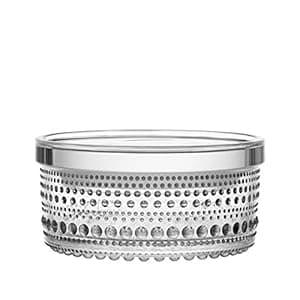 B015UT8Z0C Price: $44.99 Score: 1000.000 Category: Home Rating: 5 Votes: 1 Find similar productsKastehelmi Jar By Oiva Toikka for Iittala (4.5 x 2.25, clear). The Finnish word “kastehelmi” means “dewdrop,” which refers to the rings of small glass beads that give each piece in the Iittala Kastehelmi collection its distinct character. Originally designed by Oiva Toikka in 1964, the Kastehelmi series was relaunched in 2010. The idea of using droplets of glass as decoration came to Oiva Toikka when he was thinking of ways to hide the joint marks left by the production process. The result was Iittala Kastehelmi, which features rings of tiny glass bubbles that extend outwards from the centre of each piece. Today, as then, Iittala Kastehelmi is one of the most beloved series in the Iittala range. |  B0006A5JKA Availability: Currently unavailable Score: 5.618 Category: Home Rating: 3.7 Votes: 4 Find similar productsKosta Boda Atoll 8-1/4-Inch Vase, Jade. Amazon.com The Atoll series from Kosta Boda takes its name from the coral reef that surrounds a lagoon, and the oceanic inspiration is clear in the beautiful, flowing forms. Designed by Anna Ehrner and created by master glassmakers in Sweden, this Atoll vase features Ehrner's trademark veils of color within walls of clear glass for stunning dimension and fluidity. Its sides are sure and deep, and the opening is smoothly curved for a seamless transition from the exterior to the interior. Made by hand for unique variations on each piece, the vase complements the Atoll bowl series and measures 8-1/4 inches high. It looks lovely filled with blooms or as a standalone objet d'art. Kosta Boda recommends gently washing it by hand to maintain the glass color and integrity. --Emily Bedard From the Manufacturer About the Designer Born in 1948, Anna Ehrner has been retained by Kosta Boda since 1974 and maintains a studio at Kosta glassworks. Our life blood, says Ehrner, is the creative process that takes place in the blowing room. Experimental in style, Ehrner's work is distinguished by simple yet powerful shapes and an ability to achieve shimmering displays by using color in subtle ways. For her, the final objective is almost always a synthesis between practical utility and elegant design, even though the final piece may be years in the making. Ehrner takes inspiration from nature--the lagoons of the Pacific, the Northern lights--and veils of color inside the crystal have also become something of a trademark in her art glass. She is the originator of sales successes such as the Line glasses and the Atoll series of bowls. About Kosta Boda With characteristic craftsmanship and good design, Kosta Boda has become one of the leading glasshouses in the world. The company's three glassworks in the villages of Kosta, Boda, and Åfors each have exciting individual stories of their own yet stand together under the common brand name Kosta Boda. The corps of designers currently on retainer at Kosta Boda works with both utilitarian and art glass. Glass results from a great many meetings between people--artists, craftspeople, and lovers of glass. The artists of Kosta Boda have a decisive role to play in all the creative stages of the process. The cooperation between the designers and the skilled craftspeople is very close; indeed, it is essential if the designers are to transfer their intentions to the glass. The History of Kosta Boda Kosta, the parent glassworks of Kosta Boda and the oldest glassworks in Sweden still in operation, has a fascinating history that forms a valuable part of Swedish cultural heritage. The glassworks was founded in 1742 by the governors of the counties of Kronoberg and Kalmar, Anders Koskull and Georg Bogislaus Stael von Holstein, both former generals in the army of Karl XII and distinguished veterans of the battle of Narva, among others. The two county governors founded the glassworks upon the instructions of Fredrik I and modeled it on Continental glassworks. The works was situated deep in the spruce forests of Småland, on a site midway between the two country towns, and near a village that was then known as Dåfvedshult. The main reason for choosing this location was the unlimited availability of wood. Enormous quantities of wood were naturally required to keep the glassmaking furnaces burning day and night. Both of the founders wanted their names to be remembered, so the works was christened Kosta, from the initial letters-- Ko and Sta --of the surnames of both the Carolinian generals. After a time the entire community was renamed after the growing glassworks. During the first 150 years, the glassworks in Kosta produced only utility glass, including window glass for the building of Tessin's Royal Palace, bottles and glass for the royal household, and chandeliers for churches. The first glassblowers were immigrant glass masters from Böhmen. They became the founding fathers of the glassblowing families, which passed down craft skills from generation to generation. Swedish sand was used to manufacture crystal glass, but nowadays pure silica sand is imported from Belgium, since the Swedish sand contains iron oxide that gives the glass a green tinge. Under the management of glass masters from Kosta, a succession of glassworks sprang up in the forests of Småland in the regions around Växjö and Kalmar. Kosta therefore has good reason to call itself the parent works of the entire Swedish Kingdom of Crystal. Until the end of the 19th century, the glass from Kosta was designed by the glassblowers themselves. At the Stockholm exhibition in 1897, the glassworks was criticized for the uniformity of its glass, which led to the idea of enlisting designers and artists in production. The first designer to be employed by Kosta was Gunnar Wennerberg. The year was 1898. Ever since then a large number of artists and designers have enriched the glassmaking tradition of the works with their artistic talents. Today, Kosta Boda has a unique right to describe itself as an art industry, in which designers and craftspeople work closely together in the ongoing development of handmade utility glass and art glass. This diversity of individual artistic expression and the free and uninhibited creative process have become the distinguishing characteristics of the Kosta Boda brand. In addition to the parent works in Kosta, Kosta Boda today includes the two daughter works of Boda (founded in 1864) and Åfors (founded in 1876), a partnership that was formed in 1964. Both Boda and Åfors were originally relatively simple glassworks that manufactured utility glass. Boda experienced a period of glory in the 1960s and 1970s, under the innovative and dynamic artistic leadership of Erik Höglund, a heritage carried on by Kjell Engman and Monica Backström. Åfors has been the home of the designer couple Ulrica Hydman-Vallien and Bertil Vallien, who, together with Gunnel Sahlin and Olle Brozén, brought a renaissance to the small glassworks and local community. In 1990 Kosta was acquired by its former competitor Orrefors. Orrefors/Kosta Boda was in turn acquired by the Danish company Royal Copenhagen in 1997, and the design group Royal Scandinavia was formed. The group also includes Georg Jensen, Royal Copenhagen, and Holmegaard. Colorful, handmade art glass from the works in Kosta, Boda, and Åfors have made Kosta Boda one of Sweden's strongest brands and one of the world's leading glass companies. Glass from Kosta Boda is sold all over the world. Roughly 50 percent of production is sold outside Scandinavia, with some of the biggest markets in the U.S., Japan, Germany, and Australia. The origins of this glass, the living tradition of craftsmanship developed in the glassworks in Kosta, Boda, and Åfors, is a heritage that every Swede has a right to feel proud of. Taking Care of Kosta Boda Pieces Handmade and hand-painted glass (especially the latter) does not do well in the dishwasher. Wash by hand in hot water--though not too hot--with a little washing-up liquid. Washing in very hot water will eventually destroy the luster of the glass. Rinse in water of about the same temperature as you washed it in. To avoid cracking the glass, make sure you do not expose it to excessive temperature differences. To avoid lines, dry with a soft cloth that won't shed lint. The edge of the glass is its most fragile part. When you put the glass back in the cupboard, stand it on its foot and make sure the edge does not come into contact with other glasses or objects. The Mark or Signature on Kosta Boda Pieces Products are marked with the words Kosta Boda , the name of the artist, and the article number (seven digits). Painted pieces are signed with a painted signature with the designer's and the painter's initials. Engraved pieces also have the engraver's signature near the designer's name. Besides designing glass for the regular Kosta Boda collection, our artists are also free to work with art glass--limited-edition, specially signed pieces that are often much sought after by collectors. Kosta Boda art glass is divided into two categories: unique pieces and limited editions. Unique pieces are, of course, just that. No more than one piece is made of any particular item. Limited editions are manufactured in runs of between 25 and 1,000 pieces. All art glass is marked with the product number, the name of the artist, and the size of the edition so that the purchaser will know exactly how many pieces there are in that particular series. Editions comprising less than 60 pieces are individually numbered, e.g. 25/60. |
 B01MSIACCL Price: $48.6 Score: 5.181 Category: Home Rating: 5 Votes: 1 Find similar productsエールネット Iga Oribe No. 2 Tokuri & Glass Set of 2 Ceramic Mino Ware. A great selection of gifts for yourself or to give as a gift. Comes in a box, making it the perfect gift. From Mother's Day, Father's Day, Christmas, Birthday (Birthday), Valentine's Day, and other gifts, baby showers, housewarmings, coming-of-age celebrations, housewarming, coming-of-age celebrations, school entrance celebrations, kindergarten entrance celebrations, first annual celebrations, celebrations, celebrations, celebrations, celebrations, celebrations, celebrations, celebrations, celebrations, first annual celebrations, festivals, celebrations, celebrations, celebrations, festivals, celebrations, celebrations, celebrations, celebrations, celebrations, celebrations, celebrations, celebrations, celebrations, celebrations, celebrations, celebrations, celebrations, celebrations, celebrations around celebrations of celebrations of celebrations of celebrations of festivals, celebrations of festivals, celebrations and celebrations. Celebration / Job Celebration It can be used for various occasions such as housewarming celebrations and respect for the elderly celebrations, mid-year parties, year-end parties, golf competitions and bowling competitions prizes, memorabilia, and novelty. Perfect for restaurants, coffee shops, taverns, Japanese and Western restaurants and more. |  B01L69HAXI Price: $22.95 Score: 5.128 Category: Home Rating: 4.6 Votes: 66 Find similar productsDock 6 Pottery Small Wasabi/Trinket Dish with Fused Glass, Purple/Green. These beautiful little dishes have an organic quality that's dramatically enhanced by the crackled fused glass which lines the bottoms. The sparkling crystallization and multicolored highlights mimic natural gemstones created by the forces of nature, and the spontaneous character of the process means each piece has a unique personality. Variations in size, color, and texture should be expected and appreciated. Kerry Brooks has been a potter since 1988, learning her craft in Ann Arbor, Michigan and now working from her studio and gallery, Dock 6 Pottery, in the Longfellow neighborhood of South Minneapolis. She creates primarily wheel-thrown, high-fired stoneware. Pieces without fused glass are functional while those with fused glass are mainly decorative, but can be used with dry, non-staining foods and hand washed. |
 B003ZV2RKC Availability: Currently unavailable Score: 5.128 Category: Home Rating: 2.7 Votes: 5 Find similar productsBormioli Rocco Quattro Stagioni Jar with Lid - 0.15 Liter (5 oz). The iconic Quattro Stagioni Jelly Jar has a 15 cl ( 5 oz) capacity to store or gift homemade jams, jellies, sauces, or pickled vegetables. Use on the counter or in the pantry for storing dry goods, in the bathroom for bath salts, or in a craft room for keeping notions. The classic shape of this 5-ounce jar is embossed on one side with a swirling script spelling out 'Quattro Stagioni' (Four Seasons) and a decorative motif on the other side showing fruit, flowers, and a beehive surrounded by twining vines. Use if for a colorful food display or as a vessel for homemade food gifts. Your imagination only limits you! The same floral design is repeated in black on the gold lids. The interior seal of the air-tight lid is guaranteed to keep freshness in and air out so it can even be used for home canning projects. Instructions for home canning come with each jar. The glass is odor and stain proof, food-safe, and can be put in the dishwasher and made in Italy. Sold as a single glass jar Sold as a single glass jar Capacity 15 cl - 5 oz Capacity 15 cl - 5 oz Height with lid 83 mm - 3.25 Height with lid 83 mm - 3.25 Diameter 75 mm - 3 Diameter 75 mm - 3 Lid size 56 mm Lid size 56 mm Made of soda-lime glass Made of soda-lime glass Dishwasher Safe Dishwasher Safe About Bormioli RoccoSince 1825 Bormioli Rocco has made glass to give your food stories their best setting. At Bormioli Rocco, they believe in the table is a place where some of the most profound and most authentic relationships are created, revived, and celebrated. At the table is where you celebrate special events and anniversaries and where each day can be made a bit more special. They designed to give the table a strong personality and create a unique atmosphere in every room without sacrificing functionality. |  B00074PA1S Availability: Currently unavailable Score: 5.128 Category: Home Rating: 5 Votes: 3 Find similar productsKosta Boda Catwalk 6.75Vase. Product Description Catwalk models in glass are the theme of Kjell Engman's new fashion-inspired vase series, appropriately named Catwalk. The vases, which come in five different sizes, are equally stylish when brought together in a group, where form and décor bring unity to the lightness and fluid movement of the individual pieces. Amazon.com In his Catwalk line, Swedish designer Kjell Engman transfers both his wit and his interest in the fashion world onto a series of sculptural glass vases. The shortest of the collection at 6-5/8 inches, this freeform white vase is just wide enough to hold candies or nuts as a bowl as well as a bouquet of short-stemmed tulips. On the side of the vase you'll see a pair of female legs, depicted from dress hem to jauntily pointed shoes. A conversation starter if ever there was one. Kjell Engman often produces lighthearted pieces that relate to folktales, storytelling, or the world of entertainment. In fact, he is well-known in Sweden for his larger installations involving light and sound. His collectible Catwalk pieces are handcrafted in Sweden and arrive in a Kosta Boda box, signifying the highest artistry in both design and implementation. --Ann Bieri From the Manufacturer About the Designer: Kosta Boda since 1978 and has a studio at Boda glassworks. A tirelessly productive visual artist with unbounded imagination and a passion for narrative, Engman finds free expression through both utility glass and art glass. He gets his inspiration from the most diverse sources, not least from the animal kingdom and the world of music and entertainment. He often works on large installations in which he also combines elements of sound and light. Frequently commissioned for public works both in Sweden and abroad, he is personally responsible for one fifth of Kosta Boda's catalog range. About the Kosta Boda: With characteristic craftsmanship and good design, Kosta Boda has become one of the leading glasshouses in the world. The company's three glassworks in the villages of Kosta, Boda, and Åfors each have exciting individual stories of their own yet stand together under the common brand name Kosta Boda. The corps of designers currently on retainer at Kosta Boda works with both utilitarian and art glass. Glass results from a great many meetings between people--artists, craftspeople, and lovers of glass. The artists of Kosta Boda have a decisive role to play in all the creative stages of the process. The cooperation between the designers and the skilled craftspeople is very close; indeed, it is essential if the designers are to transfer their intentions to the glass. The History of Kosta Boda: Kosta, the parent glassworks of Kosta Boda and the oldest glassworks in Sweden still in operation, has a fascinating history that forms a valuable part of Swedish cultural heritage. The glassworks was founded in 1742 by the governors of the counties of Kronoberg and Kalmar, Anders Koskull and Georg Bogislaus Stael von Holstein, both former generals in the army of Karl XII and distinguished veterans of the battle of Narva, among others. The two county governors founded the glassworks upon the instructions of Fredrik I and modeled it on Continental glassworks. The works was situated deep in the spruce forests of Småland, on a site midway between the two country towns, and near a village that was then known as Dåfvedshult. The main reason for choosing this location was the unlimited availability of wood. Enormous quantities of wood were naturally required to keep the glassmaking furnaces burning day and night. Both of the founders wanted their names to be remembered, so the works was christened Kosta, from the initial letters--Ko and Sta--of the surnames of both the Carolinian generals. After a time the entire community was renamed after the growing glassworks. During the first 150 years, the glassworks in Kosta produced only utility glass, including window glass for the building of Tessin's Royal Palace, bottles and glass for the royal household, and chandeliers for churches. The first glassblowers were immigrant glass masters from Böhmen. They became the founding fathers of the glassblowing families, which passed down craft skills from generation to generation. Swedish sand was used to manufacture crystal glass, but nowadays pure silica sand is imported from Belgium, since the Swedish sand contains iron oxide that gives the glass a green tinge. Under the management of glass masters from Kosta, a succession of glassworks sprang up in the forests of Småland in the regions around Växjö and Kalmar. Kosta therefore has good reason to call itself the parent works of the entire Swedish Kingdom of Crystal. Until the end of the 19th century, the glass from Kosta was designed by the glassblowers themselves. At the Stockholm exhibition in 1897, the glassworks was criticized for the uniformity of its glass, which led to the idea of enlisting designers and artists in production. The first designer to be employed by Kosta was Gunnar Wennerberg. The year was 1898. Ever since then a large number of artists and designers have enriched the glassmaking tradition of the works with their artistic talents. Today Kosta Boda has a unique right to describe itself as an art industry, in which designers and craftspeople work closely together in the ongoing development of handmade utility glass and art glass. This diversity of individual artistic expression and the free and uninhibited creative process have become the distinguishing characteristics of the Kosta Boda brand. In addition to the parent works in Kosta, Kosta Boda today includes the two daughter works of Boda (founded in 1864) and Åfors (founded in 1876), a partnership that was formed in 1964. Both Boda and Åfors were originally relatively simple glassworks that manufactured utility glass. Boda experienced a period of glory in the 1960s and 1970s, under the innovative and dynamic artistic leadership of Erik Höglund, a heritage carried on by Kjell Engman and Monica Backström. Åfors has been the home of the designer couple Ulrica Hydman-Vallien and Bertil Vallien, who, together with Gunnel Sahlin and Olle Brozén, brought a renaissance to the small glassworks and local community. In 1990 Kosta was acquired by its former competitor Orrefors. Orrefors/Kosta Boda was in turn acquired by the Danish company Royal Copenhagen in 1997, and the design group Royal Scandinavia was formed. The group also includes Georg Jensen, Royal Copenhagen, and Holmegaard. Colorful, handmade art glass from the works in Kosta, Boda, and Åfors have made Kosta Boda one of Sweden's strongest brands and one of the world's leading glass companies. Glass from Kosta Boda is sold all over the world. Roughly 50 percent of production is sold outside Scandinavia, with some of the biggest markets in the U.S., Japan, Germany, and Australia. The origins of this glass, the living tradition of craftsmanship developed in the glassworks in Kosta, Boda, and Åfors, is a heritage that every Swede has a right to feel proud of. Taking Care of Kosta Boda Pieces: Handmade and hand-painted glass (especially the latter) does not do well in the dishwasher. Wash by hand in hot water--though not too hot--with a little washing-up liquid. Washing in very hot water will eventually destroy the luster of the glass. Rinse in water of about the same temperature as you washed it in. To avoid cracking the glass, make sure you do not expose it to excessive temperature differences. To avoid lines, dry with a soft cloth that won't shed lint. The edge of the glass is its most fragile part. When you put the glass back in the cupboard, stand it on its foot and make sure the edge does not come into contact with other glasses or objects. The Mark or Signature on Kosta Boda Pieces: Products are marked with the words Kosta Boda , the name of the artist, and the article number (seven digits). Painted pieces are signed with a painted signature with the designer's and the painter's initials. Engraved pieces also have the engraver's signature near the designer's name. Besides designing glass for the regular Kosta Boda collection, our artists are also free to work with art glass--limited-edition, specially signed pieces that are often much sought after by collectors. Kosta Boda art glass is divided into two categories: unique pieces and limited editions. Unique pieces are, of course, just that. No more than one piece is made of any particular item. Limited editions are manufactured in runs of between 25 and 1,000 pieces. All art glass is marked with the product number, the name of the artist, and the size of the edition so that the purchaser will know exactly how many pieces there are in that particular series. Editions comprising less than 60 pieces are individually numbered, e.g. 25/60. |
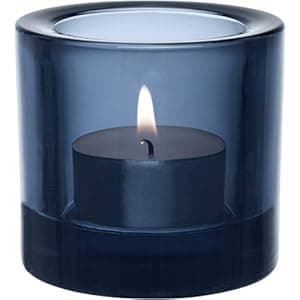 B091YHY27H Price: $28.4 Score: 5.051 Category: Home Rating: 4.4 Votes: 53 Find similar productsIittala 1007836 Kivi tealight Holder, 6 cm, rain Blue. These small, colourful jewels of light are the creations of Iittalas thorough knowledge of glass. The colours and thickness of the glass enrich the glow as it multiplies the flickers of the flame. The wide range of colours to choose from lets you create a personal combination for every season and occasion in the year. Details: , Because of its thoroughly dyed glass, the colour remains all year round, even when placed in the dishwasher , These mood lights are available in several colours, giving you choice and allowing you to combine them to your heart's content , Kivi Lanterns can work together beautifully, but can also combine well with other sets, such as the Kastehelmi lights from Iittala , The price of these mood lights are determined by the production methods and raw materials used; a clear light may, for example, only need to be heated once, but a red light must be heated up twice in order to attain the optimum level of colour. More expensive raw materials are also used in the production of such refined, red lights , Tip: a combination of three lights is particularly striking. Begin with two basic varieties such as the transparent and matt glasses. Then place a yellow springtime light or a Seville orange light among them for optimum colour effect. These colours and combinations can be skilfully and smoothly created all year round, for every season and every occasion, simply by changing lights accordingly , Hand-wash only , Designer: Heikki Orvola, 1988 Dimensions: 6 cm Colour: Rain Material: Glass Manufacturer Article Number:1007836br / Please note: The tealight pictured is purely for decoration and not included in the delivered product. , Pack contains:1 Iittala Kivi Tealight, Light Glass, Candle Holder, Lantern, Glass, Rain, 6 cm, 1007836. |  B00N97I544 Availability: Currently unavailable Score: 5.000 Category: Home Rating: 4.7 Votes: 10 Find similar products(7 H x 4 D) Authentic Hand-Blown Re-Creation 1885 Amber Buffalo Ball Jar w/Lid. (7H x 4D) Authentic Hand-Blown Re-Creation 1885 Amber Buffalo Ball Jar w/Lid, Reproduction of the early Ball fruit jar made in 1885 or 1886 in one of its First Factories in Buffalo, New York, Comes with Zinc Band, Milk Glass Top, Sealing Gasket and the Paperwork, This Glass Container has been Produced as Authentically as is Possible as the 1885 Version., ** For Display/Decoration Only - Not Made For Use - Lids Do Not Seal Properly For Use!. |
 B07C3P582J Price: $181.84 Score: 5.000 Category: Home Rating: 5 Votes: 1 Find similar productsOrrefors Mirror 6-1/4-Inch Bowl. The vases and bowls of the new Mirror line contrast smooth polished planes with softly rounded surfaces, setting up mirror images in infinite variety. In Mirror, Erika Lagerbielke demonstrates her expertise in enhancing the properties of the fabled Orrefors crystal. |  B0000CFHM6 Price: $35.17 Score: 4.975 Category: Home Rating: 4.3 Votes: 344 Find similar productsBormioli Rocco naaa Rocco Quattro Stagioni 5 oz. Canning Jar, 5 ounce. The tradition of the Bormioli Rocco Glass Company coincides with the very history of glass: the first glassworks was established in Parma in 1825. Bormioli Rocco uses the finest natural resources to create superior glass and plastic products for homes and businesses around the world. From the finest sand imported from European countries to organic glazes for the colors in the glass, all are brought together in products influenced by exhaustive design research. Over the years we have combined our time-honored craftsmanship and the passion of master glassmakers with modern technology and industrial processes. The results are beautiful and durable tableware, supremely safe pharmaceutical packaging, and bottles and jars that hold some of Italy's most iconic and delectable brands. With stemware, glasses, food storage and preserving jars, and dinnerware gracing tables around the world, quality is the cornerstone in the foundation that supports the Bormioli Rocco reputation. |