E-commerce Search Demo
AI Assisted Filters
Parameters
Query:
Category filters: All
AI Assist: ON
Page: 1
Products
Time taken: 3 Max score: 1000.000 Total hits: 100 Full time: 0.0 s
Showing 1-10 of 100 products
 B098W85FHX Price: $22.95 Score: 1000.000 Category: Electronics Rating: 4.3 Votes: 6 Find similar productsSparkFun MicroMod Teensy Processor ARM Cortex-M7 Processor Clock speeds up to 600MHz 16MB Flash Memory 102k RAM Memory 7X Serial UART Ports 4X I2C Buses 2X SPI CAN-Bus 12x GPIO USB Host and Device. The SparkFun MicroMod Teensy Processor leverages the awesome computing power of the NXP iMXRT1062 chip and pairs it with the M.2 MicroMod connector to allow you to plug it into your choice of compatible MicroMod Carrier Board. With the M.2 MicroMod connector, connecting your Teensy Processor is a breeze. Simply match up the key on your processor's beveled edge connector to the key on the M.2 connector and secure it with a screw (included with all Carrier Boards). Adding a Teensy to your desired project has never been easier! The Teensy Processor Board boasts some impressive computing power with an ARM Cortex-M7 processor operating at clock speeds up to 600MHz, 16MB Flash Memory and 1024K RAM Memory. On top of all that processing power, the board features seven serial UART ports, four I2C buses, two SPI ports, CAN-Bus, 12 GPIO, dedicated digital, analog, and PWM pins, USB Host and Device capability up to 480Mbit/s, digital audio and since many of the pins on the iMXRT1062 support multiple signal types you can customize it even further depending on your project's needs. Teensy is a registered trademark of PJRC. The MicroMod Teensy is a collaboration between PJRC and SparkFun. MicroMod is a modular interface ecosystem that connects a microcontroller “processor board” to various “carrier board” peripherals. Utilizing the M.2 standard, the MicroMod standard is designed to easily swap out processors on the fly. Pair a specialized carrier board for the project you need with your choice of compatible processor!. | 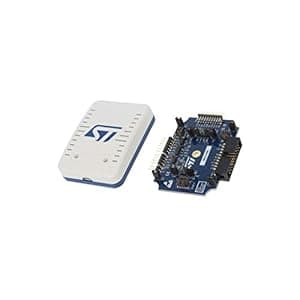 B07KPMK8VX Availability: Currently unavailable Score: 7.634 Category: Electronics Rating: 2 Votes: 1 Find similar productsSTLINK-V3 Modular in-Circuit debugger and Programmer for STM32/STM8. The STLINK-V3SET is a modular stand-alone debugging and programming probe for the STM8 and STM32 microcontrollers. It is composed of a main module and a complementary adapter board. The SWIM and JTAG/SWD interfaces are used to communicate with any STM8 or STM32 microcontroller located on an application board. The STLINK-V3SET also provides a Virtual COM port interface allowing the host PC to communicate with the target microcontroller through one UART, and bridge interfaces (SPI, I2C, CAN, GPIOs) allowing for instance the programming of the target through bootloader. The modular architecture of STLINK-V3SET enables to extend its main features through additional modules such as the adapter board. Key Features: Stand-alone probe with modular extensions Self-powered through a USB connector (Micro-B) USB 2.0 high-speed compatible interface Direct firmware update support (DFU) JTAG / serial wire debugging (SWD) specific features: 3 V to 3.6 V application voltage support and 5 V tolerant inputs, Flat cables STDC14 to MIPI10 / STDC14 / MIPI20 (connectors with 1.27 mm pitch), JTAG communication support, SWD and serial wire viewer (SWV) communication support SWIM specific features (only available with adapter board MB1440): 1.65 V to 5.5 V application voltage support, SWIM header (2.54 mm pitch), SWIM low-speed and high-speed modes support Virtual COM port (VCP) specific features: 3 V to 3.6 V application voltage support on the UART interface and 5 V tolerant inputs, VCP frequency up to 15 MHz, Available on STDC14 debug connector (not available on MIPI10) Multi-path bridge USB to SPI/UART/I2C/CAN/GPIOs specific features: 3 V to 3.6 V application voltage support and 5 V tolerant inputs, Signals available on adapter board only (MB1440) Drag-and-drop Flash programming Two color LEDs: communication, power. |
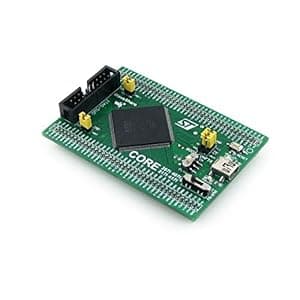 B07NSNGWKS Availability: Currently unavailable Score: 6.849 Category: Electronics Rating: 2 Votes: 1 Find similar productsWaveShare Core407I (6102). Core407I is a small STM32 development board that features an STM32F407IGT6 device as the microcontroller, supports further expansion. It is ideal for starting application development with STM32F family. As a minimal ready-to-run system, the Core407I integrates USB communication interface, JTAG/SWD programming/debugging interface, clock circuit, USB power management, boot mode selection, and so on. Furthermore, pin headers on the backside allow the Core407I to be plugged-in your application board and act as the MCU core circuit in your system. All the I/O ports are accessible on the pin headers, and the header pitch is designed as 2.0mm to achieve smaller pcb size. | 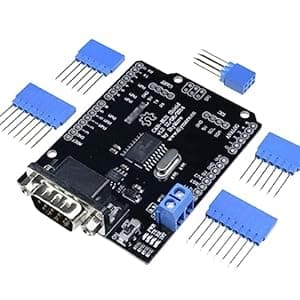 B0C3R1ZRTV Price: $15.99 Score: 6.757 Category: Electronics Rating: 3.6 Votes: 4 Find similar productsMICROVER- Can Bus Shield Development Board, DC 5-12V Controller and Transceiver, CanBus Shield Adopts MCP2515, SPI Interface 9 Pin Standart Sub-D Connector Expansion Module, Compatible for Arduino. CAN-BUS, due to its frequent use in industrial applications. CAN-BUS stands out in long-distance transmissions with its moderate communication speed and high security. You can incorporate the preferred CAN-BUS structure, especially in modern machines and complex robot systems, into your circuit using the CAN-BUS Shield. The CAN-BUS Shield utilizes the CAN-BUS transceiver and the SPI-compatible MCP2515 CAN-BUS controller. It can be seamlessly connected to Arduino/Freaduino and Seeeduino boards. With the help of the OBD-II conversion cable and the OBD-II library, you can create an embedded diagnostic device or a data logger. The CAN-BUS Shield also features various communication port supports, analog and digital IOs, and PWM outputs. UART, SPI, and I2C communication ports can be used to communicate with different units. Additionally, the CAN-BUS Shield has 6 analog IO pins, 3.3V and 5V power sources, 6 PWM outputs, and 14 digital IO pins, making it a shield board that enables interaction with different modules. Features: 1 Mb/s V2.0B application 10MHz upward SPI interface Ariduino/Freaduino is fully compatible Standard (11 bits) and extended (29 bits) data and remote frames Industry standard 9-pin Sub-d connector Get two to the main message store function Buffer with DC5-12V operating voltage Size: 78mm x 53.5mm The package includes: 1pc *MCP2515 CAN BUS Shield expansion board Development board CAN communication board Microver is here for your electronic and embedded needs. Please stand by for our other products. |
 B08DD2G9D8 Price: $18.99 Score: 6.667 Category: Electronics Rating: 4.1 Votes: 51 Find similar productsACEIRMC Pro Micro for Atmega32U4 5V 16MHz Bootloadered IDE Micro USB Pro Micro Development Board Microcontroller Compatible for Pro Micro Serial Connection with arduino Pin Header (3pcs). Features: ATmega32U4 running at 5V/16MHz Supported under IDE v1.0.1 4 x 10-bit ADC pins, 12 x Digital I/Os Rx and Tx Hardware Serial Connections On-Board Micro-USB connector for programming Pay attention to : 1.The acceptable voltage range is 6 to 9 V 2.When you open the IDE software, could you please go to the tool and choose the board Explanation: 1. The Pro Micro is similar to the Pro mini except with a ATmega32U4 on board. The USB transceiver inside the 32U4 allows us to add USB connectivity on board and do away with bulky external USB interface. 2. This tiny little board does all of the neat-o tricks that you're familiar with: 4 channels of 10-bit ADC, 5 PWM pins, 12 DIOs as well as hardware serial connections Rx and Tx. Running at 16MHz and 5V, this board will remind you a lot of your other favorite -compatible boards but this little guy can go just about anywhere. If you're supplying unregulated power to the board, be sure to connect to the RAW pin on not VCC. |  B09Y8PGMC7 Price: $19.99 Score: 6.579 Category: Electronics Rating: 4.8 Votes: 38 Find similar productsAITRIP 5 PCS ESP8266 NodeMCU V3 CP2102 ESP-12F 4M Bytes Internet of Things WiFi Development Board Serial Wireless Module for Arduino IDE Micropython. Built-in Micro-USB, with flash and reset switches, easy to program Full I/O port and Wireless 802.11 supported, direct download no need to reset The chip model: CP2102; There is the way to guide you to use the new version: The command you needed to use is: esptool.py --baud 115200 --port /dev/tty.SLAB_USBtoUART write_flash -fs 32m -ff 80m --flash_mode dio 0x00000 boot_v1.7.bin 0x1000 user1.bin 0x37c000 esp_init_data_default.bin 0x37e000 blank.bin The important part is “—flash mode dio” https://github.com/espressif/esptool/wiki/SPI-Flash-Modes; Instruction & Steps of How to use: 1. Download the Compatible with Compatible with Arduino IDE, the latest version. 2. Install the IDE 3. Set up your Compatible with Compatible with Arduino IDE as: Go to File->Preferences and copy the URL below to get the ESP board manager extensions: http://arduino.esp8266.com/stable/package_esp8266com_index.json Placing the http:// before the URL lets the Compatible with Compatible with Arduino IDE use it...otherwise it gives you a protocol error. 4. Go to Tools > Board > Board Manager> Type esp8266 and download the Community esp8266 and install. 5. Set up your chip as: Tools -> Board -> NodeMCU 1.0 (ESP-12E Module) Tools -> Flash Size -> 4M (3M SPIFFS) Tools -> CPU Frequency -> 80 Mhz Tools -> Upload Speed -> 921600 Tools-->Port--> (whatever it is) 6. Download and run the 32 bit flasher exe at Github(Search for nodemcu/nodemcu-flasher/tree/master/ at Github) github.com/nodemcu/nodemcu-flasher/tree/master/Win32/Release Or download and run the 64 bit flasher exe at: github.com/nodemcu/nodemcu-flasher/tree/master/Win64/Release 7. In Compatible with Compatible with Arduino IDE, look for the old fashioned Blink program. Load, compile and upload. 8. Go to FILE> EXAMPLES> ESP8266> BLINK, it will start blinking. Package Including 5PCS * ESP8266 NodeMCU LUA CP2102 WiFi Wireless Development Board. |
 B007OWQ23Q Availability: Currently unavailable Score: 6.410 Category: Electronics Rating: 5 Votes: 3 Find similar productsVelleman VM110N USB Interface Card Module. The VM110N interface board has 5 digital input channels and 8 digital output channels. In addition, there are two analogue inputs and two analogue outputs with 8 bit resolution. The number of inputs/outputs can be further expanded by connecting more (up to a maximum of four) cards to the PC's USB connectors. All communication routines are contained in a Dynamic Link Library (DLL) K8055D.DLL. You may write custom Windows (XP or higher) applications in Delphi, Visual Basic, C++ Builder or any other 32-bit Windows application development tool that supports calls to a DLL. Source code for Visual Basic , Visual C++, Visual C#, Excel, Delphi and Borland C++ Builder included. Minimum system requirements: Pentium class CPU USB1.1 or higher connection Windows XP or higher CD ROM player and mouse DIAGNOSTIC / TEST SOFTWARE: separate output / input test clear all / set all function counter function on inputs 1 and 2 with adjustable debounce (max 2KHz depends on total I/O load) analogue output set sliders analogue input bar-graph indication 100% compatible with: VM110 & K8055 cards Specifications 5 digital inputs (0= ground, 1= open) (on-board test buttons provided) 2 analogue inputs with attenuation and amplification option (internal test +5V provided) 8 digital open collector output switches (max 50V/100mA) (on-board LED indication) 2 analogue outputs: 0 to 5V, output resistance 1K5 PWM 0 to 100% open collector outputs max 100mA / 40V (on-board LED indication) general response time: 2ms per command power supply: through USB approx. 70mA dimensions: 110 x 80mm / 4.3 x 3.2 Application for Android, plug-in for IPEmotion measurement software, AREMBEUSB ActiveX Control & Software Development Kit, and more software are available on the Velleman website. | 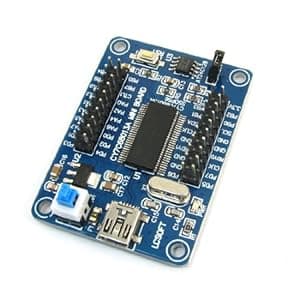 B009NR8ZY4 Availability: Currently unavailable Score: 6.329 Category: Electronics Rating: 3.9 Votes: 4 Find similar productsEZ-USB FX2LP CY7C68013A USB Development Core Board Logic Analyzer EEPROM. Features : Using CY7C68013A-56 chip: low-power version of the enhanced 51-core, 16KB program data areas, frequency of 48Mhz, 480Mbps high-speed transmission protocol standards, in line with USB2.0 specification, backward compatible with USB1.1. Firmware, EEPROM: Complete in-system programming solution with a USB cable directly to download firmware, on-board to provide 16K (24LC128) a large program memory (EEPROM), used as storage VID / PID and the USB firmware, the program space to meet the CY7C68013A Needs. All the GPIO pin through the 2.54mm standard leads to very convenient for learners toexpand DIYdesign. With the board firmware can be achieved through the core function of the logic analyzer PDF format, provide the schematic and code Package included: 1 x CY7C68013A core development board. |
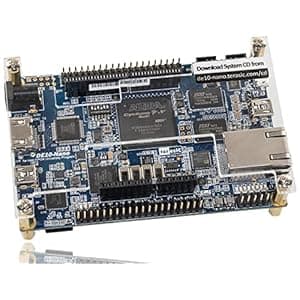 B0B6BY2LQW Availability: Currently unavailable Score: 6.329 Category: Electronics Rating: 4.4 Votes: 2 Find similar productsCBHIOARPD DE10-Nano Kit. Demo Board Type:ARMOrigin:CN(Origin)The DE10-Nano Development Kit presents a robust hardware design platform built around the Intel System-on-Chip (SoC) FPGA, which combines the latest dual-core Cortex-A9 embedded cores with industry-leading programmable logic for ultimate design flexibility. Users can now leverage the power of tremendous re-configurability paired with a high-performance, low-power processor system. Altera’s SoC integrates an ARM-based hard processor system (HPS) consisting of processor, peripherals and memory interfaces tied seamlessly with the FPGA fabric using a high-bandwidth interconnect backbone. The DE10-Nano development board is equipped with high-speed DDR3 memory, analog to digital capabilities, Ethernet networking, and much more that promise many exciting applications.The DE10-Nano Development Kit contains all the tools needed to use the board in conjunction with a computer that runs the Microsoft Windows XP or later.DE10-Nano KitThe DE10-Nano board has many features that allow users to implement a wide range of designed circuits, from simple circuits to various multimedia projects.The following hardware is provided on the board:FPGA DeviceIntel Cyclone V SE 5CSEBA6U23I7 device (110K LEs)Serial configuration device – EPCS64 (revision B2 or later)USB-Blaster II onboard for programming; JTAG ModeHDMI TX, compatible with DVI 1.0 and HDCP v1.42 push-buttons4 slide switches8 green user LEDsThree 50MHz clock sources from the clock generatorTwo 40-pin expansion headersOne Arduino expansion header (Uno R3 compatibility), can be connected with Arduino shieldsOne 10-pin Analog input expansion header (shared with Arduino Analog input)A/D converter, 4-pin SPI interface with FPGA. | 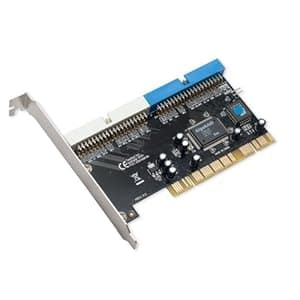 B002R0DZWG Availability: Currently unavailable Score: 6.250 Category: Electronics Rating: 2.5 Votes: 3 Find similar productsSyba 2 x ATA/133 IDE PCI ITE Chipset SY-PCI45004. Compliant with UDMA 5 ATA/100 or UDMA 6 ATA/133 Specification. Compliant with ATA/ATAPI-5 or ATA/ATAPI-6 Specification. Supports maximum data transfer rate of 100MB/s or 133MB/s. Compliant with PCI Specification Revision 2.1 & 2.2. Compliant with PCI IDE Controller Revision 1.0. Compliant with Programming interface for Bus Master IDE Controller Revision 1.0. Two independent Ultra ATA channels with 128/256 bytes buffer per channel. Connect up to four IDE/ATA devices (coexist with On-board IDE ports), ATA-2, IDE and ATAPI devices. Supports Ultra and Multi-Word DMA timing modes. Enhanced data integrity of transferred data with CRC (Cyclical Redundancy Check) protection and verification. Built-in 80pin detect circuitry. |