E-commerce Search Demo
AI Assisted Filters
Parameters
Query:
Category filters: All
AI Assist: ON
Page: 1
Products
Time taken: 3 Max score: 1000.000 Total hits: 100 Full time: 0.0 s
Showing 1-10 of 100 products
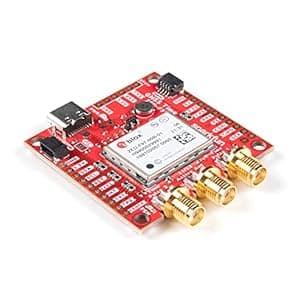 B09R6JV4TJ Price: $299.95 Score: 1000.000 Category: Electronics Rating: 3.2 Votes: 2 Find similar productsSparkFun GNSS Timing Breakout-ZED-F9T (Qwiic)-Compatible w/Arduino Multi-Band GNSS Receiver-Up to 5 nanosecond Timing Accuracy w/a Standard Position Lock-GPS GLONASS Galileo & BeiDou Constellations. The SparkFun GNSS Timing Breakout offers a unique entry into SparkFun's geospatial catalog featuring the ZED-F9T GNSS receiver from u-blox. The ZED-F9T provides up to five nanosecond timing accuracy under clear skies with no external GNSS correction making it perfect for applications where timing accuracy is imperative. Need an extremely accurate time reference to maximize the efficiency of your IoT network of 5G devices? The ZED-F9T GNSS Timing Breakout could be the perfect solution. The ZED-F9T is a multi-band GNSS module that supports L1/L2/E5b bands and operates on all major constellations (GPS, GLONASS, Galileo and BeiDou) concurrently making it extremely versatile and able to retain its timing precision even the module loses lock with one or more of the visible constellations. This breakout shares a similar design as the SparkFun GPS-RTK-SMA Breakout to create a small but comprehensive development tool for the ZED-F9T. The design includes a USB-C connector for primary power and communication, two Qwiic connectors for communicating over I2C using the SparkFun Qwiic system, three SMA connectors for the antenna and timing pulse signals as well as a host of PTH pins allowing direct interaction with most of the ZED-F9T's pinout. The GNSS Timing Breakout also includes an on-board rechargeable backup battery that provides power to the RTC on the ZED-F9T. This reduces the time-to-first fix from a cold start (~24s) to a hot start (~2s). The SparkFun Qwiic Connect System is an ecosystem of I2C sensors, actuators, shields and cables that make prototyping faster and less prone to error. All Qwiic-enabled boards use a common 1mm pitch, 4-pin JST connector. This reduces the amount of required PCB space, and polarized connections mean you can’t hook it up wrong. | 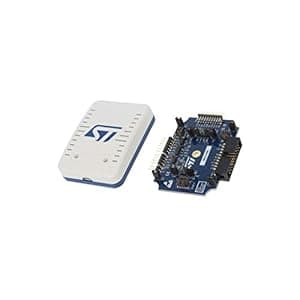 B07KPMK8VX Availability: Currently unavailable Score: 6.849 Category: Electronics Rating: 2 Votes: 1 Find similar productsSTLINK-V3 Modular in-Circuit debugger and Programmer for STM32/STM8. The STLINK-V3SET is a modular stand-alone debugging and programming probe for the STM8 and STM32 microcontrollers. It is composed of a main module and a complementary adapter board. The SWIM and JTAG/SWD interfaces are used to communicate with any STM8 or STM32 microcontroller located on an application board. The STLINK-V3SET also provides a Virtual COM port interface allowing the host PC to communicate with the target microcontroller through one UART, and bridge interfaces (SPI, I2C, CAN, GPIOs) allowing for instance the programming of the target through bootloader. The modular architecture of STLINK-V3SET enables to extend its main features through additional modules such as the adapter board. Key Features: Stand-alone probe with modular extensions Self-powered through a USB connector (Micro-B) USB 2.0 high-speed compatible interface Direct firmware update support (DFU) JTAG / serial wire debugging (SWD) specific features: 3 V to 3.6 V application voltage support and 5 V tolerant inputs, Flat cables STDC14 to MIPI10 / STDC14 / MIPI20 (connectors with 1.27 mm pitch), JTAG communication support, SWD and serial wire viewer (SWV) communication support SWIM specific features (only available with adapter board MB1440): 1.65 V to 5.5 V application voltage support, SWIM header (2.54 mm pitch), SWIM low-speed and high-speed modes support Virtual COM port (VCP) specific features: 3 V to 3.6 V application voltage support on the UART interface and 5 V tolerant inputs, VCP frequency up to 15 MHz, Available on STDC14 debug connector (not available on MIPI10) Multi-path bridge USB to SPI/UART/I2C/CAN/GPIOs specific features: 3 V to 3.6 V application voltage support and 5 V tolerant inputs, Signals available on adapter board only (MB1440) Drag-and-drop Flash programming Two color LEDs: communication, power. |
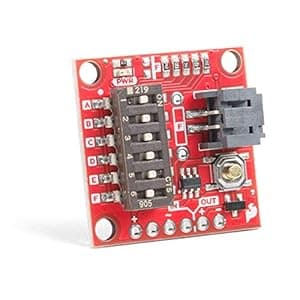 B07T6Y93NB Price: $12.53 Score: 6.623 Category: Electronics Rating: 3.4 Votes: 10 Find similar productsSparkFun (PID 15353 Nano Power Timer - TPL5110. Sometimes we want our projects on, but sometimes we want to turn them off for a while to save power. The SparkFun Nano Power Timer will run while only consuming minimal power (approximately 35nA) and turn your project on after a set amount of time. When you are done polling your sensors, posting data to the web, writing to your logger, or planning world domination, your microcontroller can tell the Nano Power Timer to turn off the power. No more running your microcontroller all day when you only want to read the ambient temperature once per hour. The TPL5110 delay is configured with the use of resistors. We've added a six-way DIP switch to select one of the five preinstalled resistors. The sixth switch is attached to a pad to add your own PTH (or SMD) resistor. The delays associated with the preinstalled headers are shown on the bottom of the board for quick setup. Additionally, you can select more than one switch to combine the resistors in parallel (up to 26 options not including the custom resistor), check out the hookup guide for a nice chart as to the total resistance and corresponding delay for each combination. The Nano Power Timer can handle voltages between 1.8V and 5.5V as well as current up to 1.1A with times from 100ms to two hours (preconfigured settings range from 30s to 2h). You will find a button on the board which will allow you a quick override to the delay so you can turn your project on whenever you like. | 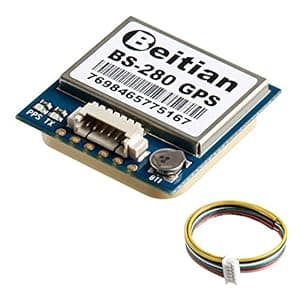 B08HMGXBZ4 Price: $19.99 Score: 6.329 Category: Electronics Rating: 4.4 Votes: 35 Find similar productsBS-280 GPS Module Glonass Module Navigation RS-232 Level (Arduino GPS, Drone Microcontroller GPS Receiver) for 51 Microcontroller STM32 Arduino UNO R3 with IPEX Antenna High Sensitivity. Product Advantages: This GPS moduel has 4M FLASH, can store the configuration permanently. Small size, low power consumption and high ensitivity makes diy possible Electrical Characteristics: Chipset: G7020-KT Frequency: GPS L1, SBAS L1, QZSS L1 Receiving Format: GPS, SBAS, QZSS Channels: 56 Searching Channel Sensitivity: Tracking: -162dBm Reacquisition: -160dBm Cold Start: -148dBm Accuracy: Position Horizontal:2.0 m (Typical Open Sky) Velocity: 0.1m/sec 95% (SA off) Timing: 1us synchronized to GPS time Acquisition Time: Cold Start: 29s Warm Start: 25s Hot Start: 1s Data Output: Support Rate: 4800bps to 921600bps, Default 9600bps Data Level: TTL Level Data Protocol: NMEA-0183 NMEA Message: RMC, VTG, GGA, GSA, GSV, GLL Update Rate:1Hz-10Hz, Default 1Hz FLASH: 4M FLASH, Store the configuration permanently Operational Limits: Altitude: <50,000m Velocity: <515m/s Acceleration: <4g Power Consumption: VCC: DC Voltage 3.6V-5.5V, Typical: 5.0V Current: Capture 45mA/5.0V Built-in LED: TX LED: blue. The data output, TX LED flashing PPS LED: red. PPS LED not bright when GPS not fixed, flashing when fixed Specifications: Dimension: 28mm*28mm*8mm Weight: 11.5g \ Connector:1.25mm 6pins connector Environment: Operating Temp: -40 °C ~ +85°C Storage Temp: -40°C ~ +105°C Application areas: Vehicle-mounted Handheld devices such as PDAs Vehicle monitoring Mobile phones, camcorders and other mobile positioning systems Sharing bike Sharing mobile power. Package Including 1 * GPS Module with Built-in Antenna. |
 B017ZZHVCW Availability: Currently unavailable Score: 6.061 Category: Electronics Rating: 3 Votes: 3 Find similar productsSparkfun XBee Explorer Serial. The SparkFun XBee Explorer Serial is a simple to use, RS232 to serial base unit for the XBee line. This unit works with all XBee modules including the Series 1 and Series 2.5, standard and Pro version. Just plug the unit into the XBee Explorer, attach a RS232 cable, and you will have direct access to the serial and programming pins on the XBee unit. The board also supports DTR communication so you can reprogram and configure the XBee unit. | 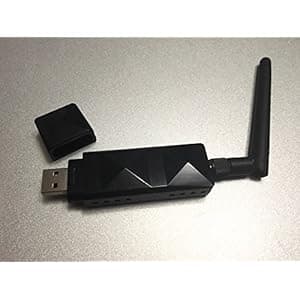 B01N1YHMMA Availability: Currently unavailable Score: 6.024 Category: Electronics Rating: 2.8 Votes: 4 Find similar productsiFrogLab LoRa USB gateway, for Raspberry Pi, Linux, Windows, Mac LoRa, LoRaWAN, IOT, 433/868Mhz. Features: Frequency Range: 868/900/915MHz Modulation: FSK/GFSK/MSK/LoRa LoRa gatewaySPI Data Interface Sensitivity: -137dBmOutput Power: +20dBm Data Rate: <300 kbps 127dB dynamic Range RSSI Excellent blocking immunity Preamble detection Automatic RF sense and CAD monitor Built-in bit synchronizer for clock recovery Packet engine up to 256 bytes with CRCWorking Temperature: -40°C ~+80°C Build-in temperature sensorStandby current: ≤ 1uASupply voltage: 1.8~3.6VFor more details please see the iFrogLab websitePlease Note that this item requires two (2) LoRa devices to form a useful network.We have less expensive devices that can be paired with this Gateway for sale on Amazon. |
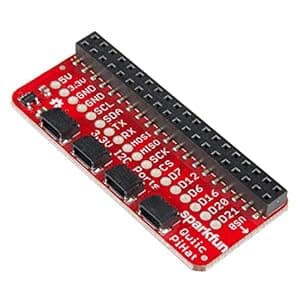 B078S6HZSQ Price: $8.5 Score: 5.917 Category: Electronics Rating: 4.2 Votes: 10 Find similar productsSparkFun Qwiic HAT for Raspberry Pi -Connect I2C sensors & accessories to a standard 2x20 GPIO header Pi Tin compatible 4 Qwiic connectors Daisy chain sensors & accessories Useful GPIO pins broken out. The SparkFun Qwiic HAT for Raspberry Pi (not included) is the quickest and easiest way to enter into SparkFun’s Qwiic ecosystem while still using that Raspberry Pi that you’ve come to know and love. The Qwiic HAT connects the I2C bus (GND, 3.3V, SDA and SCL) on your Raspberry Pi to an array of Qwiic connectors on the HAT. Since the Qwiic system allows for daisy chaining boards with different addresses, you can stack as many sensors as you’d like to create a tower of sensing power! The Qwiic Pi HAT has four Qwiic connect ports, all on the same I2C bus. In addition, many of the useful GPIO pins on the Raspberry Pi are broken out. This HAT is compatible with any Raspberry Pi that utilizes the standard 2x20 GPIO header. It has been designed to sit to the side of the Pi, allowing it to work conveniently with a Pi Tin enclosure to connect boards to the Qwiic ports. The SparkFun Qwiic Connect System is an ecosystem of I2C sensors, actuators, shields and cables that make prototyping faster and less prone to error. All Qwiic-enabled boards use a common 1mm pitch, 4-pin JST connector. This reduces the amount of required PCB space, and polarized connections mean you can’t hook it up wrong. Note: There is a small silk error that has reversed the SDA and SCL. This is simply a cosmetic mix-up and will not impact any function with this board. | 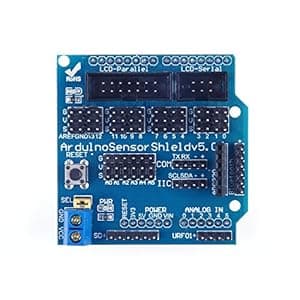 B01N2OLLH0 Availability: Currently unavailable Score: 5.917 Category: Electronics Rating: 4.3 Votes: 4 Find similar productsKNACRO UNO R3 Sensor Shield V5.0 Expansion Board for Genuino System. This new versino retains the merits of the V4.0 version. It adopts PCB immersion gold processing technology. It has Ad hoc IIC interface, Bluetooth module communication interface, SD card module communication interface, APC220 radio frequency module communication interface, RB URF v1.1 ultrasonic sensor interface, 32 servo controller interface, 12864 LCD string of line and parallel interface. Convenient to use a more independent expansion. Allow you to connect to various modules like sensors, servos, relays, buttons, potentiometers and so on. Package Included: 1 X Sensor Shield V5.0 Expansion Board. |
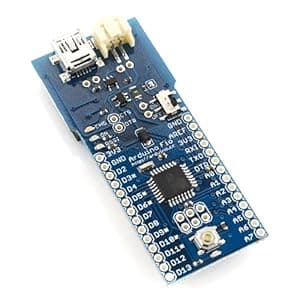 B005K0O1PA Price: $27.95 Score: 5.917 Category: Electronics Rating: 3.6 Votes: 7 Find similar productsArduino FIO. The Arduino Funnel I/O (Fio) is a board designed by Shigeru Kobayashi, based on the original design from LilyPad. Funnel is a toolkit to sketch your idea physically, and consists of software libraries and hardware. By using Funnel, the user can interface to sensors and/or actuators with various programming languages such as ActionScript 3, Processing, and Ruby. Arduino Fio is compatible with Funnel. It has connections for a Lithium Polymer battery and includes a charge circuit over USB. An XBee socket is available on the bottom of the board. The Fio has been designed to be wirelessly reprogrammable. Checkout our tutorial on wireless bootloading! Note: The miniUSB connector is used for battery charging only. To bootload new firmware, you will need an external serial connection over an FTDI Basic, cable, or other serial connection. Note: The XBee socket and FTDI connection live on the same TX/RX pins of the ATmega328. You will need to remove the XBee module while reprogramming over serial. We recommend using a wireless bootloader whenever possible to avoid this step. | 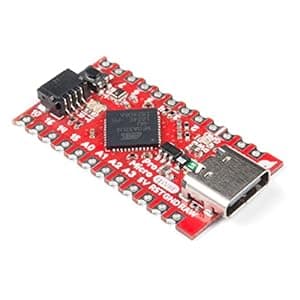 B084KPT7MH Price: $21.36 Score: 5.917 Category: Electronics Rating: 4.5 Votes: 52 Find similar productsSparkFun Qwiic Pro Micro - USB-C (ATmega32U4) - Compatible with Arduino development board 5V/16MHz microcontroller AP2112 3.3V Voltage Regulator Castellated PTH pin pads Reset button Maximum 6V input. . |