E-commerce Search Demo
AI Assisted Filters
Parameters
Query:
Category filters: All
AI Assist: ON
Page: 1
Products
Time taken: 3 Max score: 1000.000 Total hits: 100 Full time: 0.0 s
Showing 1-10 of 100 products
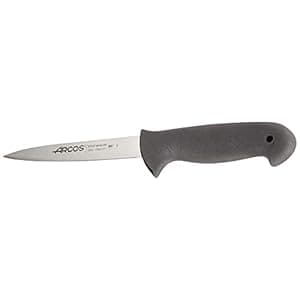 B0C2QNDD1W Price: $25.5 Score: 1000.000 Category: Home Rating: 4.8 Votes: 28 Find similar productsARCOS Colour Prof Sole Fish Knife, 7 Inches, Gray. Designed for prolonged and heavy commercial use, the Arcos Color Prof line of kitchen knives is now available for home chefs who want the same precise cutting tool used by professional chefs worldwide. Made in Spain using an exclusive Arcos stainless steel formula called Nitrum, the blade of this 7-inch slicing knife (170 mm) is enriched with nitrogen for hardening and added durability. Color coding system. Offering a revolutionary ergonomic handle design, the Color Prof series uses a core of polypropylene (PP) in the heart of the handle that's covered with a soft rubber coating. This special mixture of materials provides greater comfort and adaptability as well as being non-hygroscopic (meaning that it doesn't absorb liquids). The handle won't slip out of your hands, and it's also resistant to high temperatures. In addition to being NSF approved, these knives are also HACCP compliant--enabling you to identify each knife for cutting a specific food group by a color-coded dot system on the handle. For example, a red dot for meat and a green dot for salads makes it easy for vegetarians who want to preserve and secure their choice in the kitchen (based on European standards). Dishwasher safe, though hand washing is recommended. Arcos Nitrum Stainless Steel Nitrum is a nitrogen-enriched stainless steel formula that's found exclusively in Arcos knives. With Nitrum stainless steel, your Arcos knife will possess improved hardness for a longer lasting sharpness, enhanced microstructure for higher resistance to corrosion, and exceptional edge durability for longer periods between re-sharpening. The Nitrum production process has no negative effect on the air, water, or soil. How to Correctly Sharpen Your Arcos Knife Arcos recommends the regular use of a sharpening steel to keep the cutting edge of your knife razor sharp. Place the blade of the knife on the steel at a 20 degree angle. Place the blade of the knife on the steel at a 20 degree angle. Keep the arm that is holding the steel steady and swipe the blade lightly over the steel keeping the angle at 20 degrees. Keep the arm that is holding the steel steady and swipe the blade lightly over the steel keeping the angle at 20 degrees. Give each side of the knife an equal number of swipes (about 20). Give each side of the knife an equal number of swipes (about 20). Sharpen the other side of the blade as before, this time using the other side of the honing steel. And remember to always protect your fingers. See larger image. Tips For Use and MaintenanceWash knives immediately after use with a mild soap. Avoid prolonged contact with leftover food. Do not use bleach, soda or detergents containing chlorine or chlorides ions because they rust the steel and may cause it to lose its shine. Avoid rubbing your knives with abrasive products, hard cloths, and metallic or synthetic cleaners. If you use a dishwasher, place your knives in with the blades facing up and in separate containers from the rest of your cutlery to avoid scratching. Avoid leaving your knives submerged in water for long periods of time, especially in hard or salty water that can affect metals. Dry immediately with a soft cloth. Leaving your knives to dry in the dishwasher is not recommended. About ArcosArcos is a leading Spanish knife manufacturer and one of the oldest knife and cutlery manufacturers in the world. In 1745, Don Juan de Arcos started hand-crafting the first knives and scissors marked with the Arcos brand, and many of these pieces are displayed in the National Museum of Archeology of Madrid. Gregorio Arcos Aroca turned the small hand-crafted workshop into a mass-production factory for professional knives in 1875. And a century later, Gregorio Arcos Villanueva started the international expansion of the company. Today, Arcos is still a family owned business and proud of its remarkable heritage.To learn more about the history of Arcos, see this larger timeline image. Sharpen the other side of the blade as before, this time using the other side of the honing steel. And remember to always protect your fingers. See larger image . Tips For Use and Maintenance Wash knives immediately after use with a mild soap. Avoid prolonged contact with leftover food. Wash knives immediately after use with a mild soap. Avoid prolonged contact with leftover food. Do not use bleach, soda or detergents containing chlorine or chlorides ions because they rust the steel and may cause it to lose its shine. Do not use bleach, soda or detergents containing chlorine or chlorides ions because they rust the steel and may cause it to lose its shine. Avoid rubbing your knives with abrasive products, hard cloths, and metallic or synthetic cleaners. Avoid rubbing your knives with abrasive products, hard cloths, and metallic or synthetic cleaners. If you use a dishwasher, place your knives in with the blades facing up and in separate containers from the rest of your cutlery to avoid scratching. If you use a dishwasher, place your knives in with the blades facing up and in separate containers from the rest of your cutlery to avoid scratching. Avoid leaving your knives submerged in water for long periods of time, especially in hard or salty water that can affect metals. Avoid leaving your knives submerged in water for long periods of time, especially in hard or salty water that can affect metals. Dry immediately with a soft cloth. Dry immediately with a soft cloth. Leaving your knives to dry in the dishwasher is not recommended. About ArcosArcos is a leading Spanish knife manufacturer and one of the oldest knife and cutlery manufacturers in the world. In 1745, Don Juan de Arcos started hand-crafting the first knives and scissors marked with the Arcos brand, and many of these pieces are displayed in the National Museum of Archeology of Madrid. Gregorio Arcos Aroca turned the small hand-crafted workshop into a mass-production factory for professional knives in 1875. And a century later, Gregorio Arcos Villanueva started the international expansion of the company. Today, Arcos is still a family owned business and proud of its remarkable heritage.To learn more about the history of Arcos, see this larger timeline image. Leaving your knives to dry in the dishwasher is not recommended. About Arcos Arcos is a leading Spanish knife manufacturer and one of the oldest knife and cutlery manufacturers in the world. In 1745, Don Juan de Arcos started hand-crafting the first knives and scissors marked with the Arcos brand, and many of these pieces are displayed in the National Museum of Archeology of Madrid. Gregorio Arcos Aroca turned the small hand-crafted workshop into a mass-production factory for professional knives in 1875. And a century later, Gregorio Arcos Villanueva started the international expansion of the company. Today, Arcos is still a family owned business and proud of its remarkable heritage. To learn more about the history of Arcos, see this larger timeline image . | 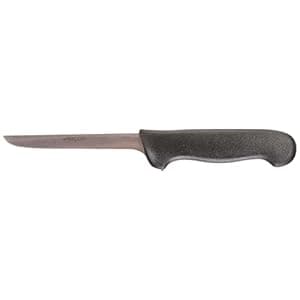 B0044R87HS Price: $21.5 Score: 11.765 Category: Home Rating: 4.6 Votes: 172 Find similar productsARCOS 2900 Boning Knife, 6 Inches, Black. Designed and engineered for heavy use, the Arcos 2900 line of kitchen knives is ideal for both professional settings as well as home kitchens. Made in Spain using an exclusive Arcos stainless steel formula called Nitrum, the blade of this 5-1/2-inch boning knife (140 mm) is enriched with nitrogen for hardening and added durability. And this knife features an NSF-certified, full colored handle in black, which allows each knife to be identified for cutting a specific food. Full color handles idea for HACCP environments. In addition to being NSF approved, knives from the Arcos 2900 range are ideal for HACCP environments that require a color coding system to keep utensils used on meat, fish, and vegetables separated. Safe and comfortable, the handle is made from injected polypropylene (PP), with a seamless joint between handle and blade thanks to the injection process. The handle won't slip out of your hands, and it's also resistant to impact and high temperatures (up to 260 degrees F). Dishwasher safe, though hand washing is recommended. Arcos Nitrum Stainless Steel Nitrum is a nitrogen-enriched, stainless steel formula that's found exclusively in Arcos knives. With Nitrum stainless steel, your Arcos knife will possess improved hardness for a longer lasting sharpness, enhanced microstructure for higher resistance to corrosion, and exceptional edge durability for longer periods between re-sharpening. The Nitrum production process has no negative effect on the air, water, or soil. How to Correctly Sharpen Your Arcos Knife Arcos recommends the regular use of a sharpening steel to keep the cutting edge of your knife razor sharp. Place the blade of the knife on the steel at a 20 degree angle. Place the blade of the knife on the steel at a 20 degree angle. Keep the arm that is holding the steel steady and swipe the blade lightly over the steel keeping the angle at 20 degrees. Keep the arm that is holding the steel steady and swipe the blade lightly over the steel keeping the angle at 20 degrees. Give each side of the knife an equal number of swipes (about 20). Give each side of the knife an equal number of swipes (about 20). Sharpen the other side of the blade as before, this time using the other side of the honing steel. And remember to always protect your fingers. See larger image. Tips For Use and MaintenanceWash knives immediately after use with a mild soap. Avoid prolonged contact with leftover food. Do not use bleach, soda or detergents containing chlorine or chlorides ions because they rust the steel and may cause it to lose its shine. Avoid rubbing your knives with abrasive products, hard cloths, and metallic or synthetic cleaners. If you use a dishwasher, place your knives in with the blades facing up and in separate containers from the rest of your cutlery to avoid scratching. Avoid leaving your knives submerged in water for long periods of time, especially in hard or salty water that can affect metals. Dry immediately with a soft cloth. Leaving your knives to dry in the dishwasher is not recommended. About ArcosArcos is a leading Spanish knife manufacturer and one of the oldest knife and cutlery manufacturers in the world. In 1745, Don Juan de Arcos started hand-crafting the first knives and scissors marked with the Arcos brand, and many of these pieces are displayed in the National Museum of Archeology of Madrid. Gregorio Arcos Aroca turned the small hand-crafted workshop into a mass-production factory for professional knives in 1875. And a century later, Gregorio Arcos Villanueva started the international expansion of the company. Today, Arcos is still a family owned business and proud of its remarkable heritage.To learn more about the history of Arcos, see this larger timeline image. Sharpen the other side of the blade as before, this time using the other side of the honing steel. And remember to always protect your fingers. See larger image . Tips For Use and Maintenance Wash knives immediately after use with a mild soap. Avoid prolonged contact with leftover food. Wash knives immediately after use with a mild soap. Avoid prolonged contact with leftover food. Do not use bleach, soda or detergents containing chlorine or chlorides ions because they rust the steel and may cause it to lose its shine. Do not use bleach, soda or detergents containing chlorine or chlorides ions because they rust the steel and may cause it to lose its shine. Avoid rubbing your knives with abrasive products, hard cloths, and metallic or synthetic cleaners. Avoid rubbing your knives with abrasive products, hard cloths, and metallic or synthetic cleaners. If you use a dishwasher, place your knives in with the blades facing up and in separate containers from the rest of your cutlery to avoid scratching. If you use a dishwasher, place your knives in with the blades facing up and in separate containers from the rest of your cutlery to avoid scratching. Avoid leaving your knives submerged in water for long periods of time, especially in hard or salty water that can affect metals. Avoid leaving your knives submerged in water for long periods of time, especially in hard or salty water that can affect metals. Dry immediately with a soft cloth. Dry immediately with a soft cloth. Leaving your knives to dry in the dishwasher is not recommended. About ArcosArcos is a leading Spanish knife manufacturer and one of the oldest knife and cutlery manufacturers in the world. In 1745, Don Juan de Arcos started hand-crafting the first knives and scissors marked with the Arcos brand, and many of these pieces are displayed in the National Museum of Archeology of Madrid. Gregorio Arcos Aroca turned the small hand-crafted workshop into a mass-production factory for professional knives in 1875. And a century later, Gregorio Arcos Villanueva started the international expansion of the company. Today, Arcos is still a family owned business and proud of its remarkable heritage.To learn more about the history of Arcos, see this larger timeline image. Leaving your knives to dry in the dishwasher is not recommended. About Arcos Arcos is a leading Spanish knife manufacturer and one of the oldest knife and cutlery manufacturers in the world. In 1745, Don Juan de Arcos started hand-crafting the first knives and scissors marked with the Arcos brand, and many of these pieces are displayed in the National Museum of Archeology of Madrid. Gregorio Arcos Aroca turned the small hand-crafted workshop into a mass-production factory for professional knives in 1875. And a century later, Gregorio Arcos Villanueva started the international expansion of the company. Today, Arcos is still a family owned business and proud of its remarkable heritage. To learn more about the history of Arcos, see this larger timeline image . |
 B0019WUS7S Availability: Currently unavailable Score: 6.494 Category: Home Rating: 4.9 Votes: 32 Find similar productsVictorinox Cutlery 8-Inch Chef's Knife, Red Fibrox Handle. Victorinox Swiss Army Cutlery Who is Victorinox? Although Victorinox is known the world over as the creator of the Original Swiss Army Knife, the company started out in 1884 as a cutlery workshop. By the time company creator Karl Elsener delivered his first pocket knife to the Swiss Army, his cutlery business was already booming. Over the next century, Victorinox cutlery became a top-rated choice among professionals worldwide, with over 300 blades to offer. Victorinox knives have regularly appeared as highly ranked and recommended kitchen tools in Cook's Illustrated, Men's Health, The Cincinnati Enquirer, New York Magazine, and Natural Health, just to name a few. In 2009, the company announced a partnership with professional chef, Daniel Humm, of Eleven Madison Park in New York City. In addition, building on the success of its cutlery business, Victorinox has brought all the same quality and expertise to a wider range of products and accessories, including other kitchen tools, pocket tools, watches, luggage, and clothing. Who is R.H. Forschner? Victorinox had been a staple in European commercial cutlery for over 50 years when approached by New York's R.H. Forschner, known since 1855 as a builder of scales for butchers, to be their sole cutlery supplier. The two companies joined forces in 1937, and R.H. Forschner subsequently became North America's dominant professional brand, as ubiquitous in the bustling meatpacking plants of the Midwest as it is in the gleaming, four-star restaurant kitchens of Midtown Manhattan. As a division of Victorinox/Swiss Army Brands, R.H. Forschner marketed cutlery under the brand name RH Forschner by Victorinox and distributed to the commercial, food service, and retail trade classes. That brand has been considered a top choice of professionals worldwide with over 300 styles of blades bearing the R.H. Forschner name. However, in 2009, in conjunction with Victorinox's 125th anniversary, the company, Victorinox Swiss Army, Inc., has decided to remove the RH Forschner name from all blades. Blades thenceforth only include the Victorinox name. What is a stamped blade? A stamped knife can usually be identified by the absence of a bolster. Stamped blades are cut into their shapes from cold-rolled pieces of steel and then ground, tempered, and sharpened. Creating them requires many less steps than forging and results in lighter, narrower blades. Some professionals prefer the thicker, heavier forged blades, but many pros, who spend much of their day cutting and slicing, enjoy a lighter knife since it's less fatiguing and easier to manipulate at speed. Stamped knives are easier to produce and therefore less expensive. They perform very well and can approach the quality of a forged blade, but not the weight or feel. Victorinox manufactures a complete range of stamped blades with unique, patented Fibrox handles and they are considered among the greatest values in the knife industry. What knives do I need to own? Knife choice or selection is determined by many factors--size, function, style, and preference. The most important factor is function. Different knives have different uses. It is important to use the proper knife for a specific task, since proper knife selection and the use of a proper-sized, sharp knife make for safe cutting. General kitchen tasks and the knife to use for them are as follows: Paring: The most common to own and use, a paring knife is generally for small cutting jobs and peeling of vegetables or fruit. The blade size is usually from three to four inches. Choose the shape and size to fit your hand. Since this is one of the more versatile knives, owning more than one is recommended. Paring: The most common to own and use, a paring knife is generally for small cutting jobs and peeling of vegetables or fruit. The blade size is usually from three to four inches. Choose the shape and size to fit your hand. Since this is one of the more versatile knives, owning more than one is recommended. Chef's: The most important tool and essential to every cook, a chef's knife is most often used in a rocking method to mince, dice, and chop vegetables and herbs. This one is known as the chef's best friend. Chef's: The most important tool and essential to every cook, a chef's knife is most often used in a rocking method to mince, dice, and chop vegetables and herbs. This one is known as the chef's best friend. Slicer: Most commonly used to slice meats, poultry, and seafood, the slicer is an important companion to any host or hostess. Slicer: Most commonly used to slice meats, poultry, and seafood, the slicer is an important companion to any host or hostess. Boning: As its name suggests, a boning knife is used to trim or remove meat and fish from the bone. Boning: As its name suggests, a boning knife is used to trim or remove meat and fish from the bone. Bread: Designed with a special edge, a bread knife makes easy work of cutting through crusty bread, pastries, or any item with a crust and a soft interior. Bread: Designed with a special edge, a bread knife makes easy work of cutting through crusty bread, pastries, or any item with a crust and a soft interior. Fillet: Most often used by pros and seasoned home chefs, the fillet knife is used to fillet meat and fish. Fillet: Most often used by pros and seasoned home chefs, the fillet knife is used to fillet meat and fish. Cleaver: An important addition to any collection, a cleaver is often used to cut or chop through bones. Cleaver: An important addition to any collection, a cleaver is often used to cut or chop through bones. Santoku: This knife combines the features of a cleaver with a chef's knife. The curved blade helps the rocking motion used for chopping, and the wide blade works well for scooping sliced food off a cutting board and for crushing garlic. The santoku can also be used to slice meat and has a narrow spine for making thin cuts. Santoku: This knife combines the features of a cleaver with a chef's knife. The curved blade helps the rocking motion used for chopping, and the wide blade works well for scooping sliced food off a cutting board and for crushing garlic. The santoku can also be used to slice meat and has a narrow spine for making thin cuts. Utility: An all-purpose knife often referred to as a sandwich knife, the utility knife peels and slices fruits and vegetables, and even carves small meats. Utility: An all-purpose knife often referred to as a sandwich knife, the utility knife peels and slices fruits and vegetables, and even carves small meats. Shaping: With its curved blade, a shaping knife is great for small precision cuts where control is essential, such as peeling, trimming, or garnishing. Shaping: With its curved blade, a shaping knife is great for small precision cuts where control is essential, such as peeling, trimming, or garnishing. What are the different knife edges and what do they do? Straight: The vast majority of Victorinox knives come with a straight or fine edge. This means it has a perfect taper along the blade and no serrations. It is designed to cut without tearing or shredding. Straight: The vast majority of Victorinox knives come with a straight or fine edge. This means it has a perfect taper along the blade and no serrations. It is designed to cut without tearing or shredding. Serrated: An edge designed with small, jagged teeth along the edge. Serrated: An edge designed with small, jagged teeth along the edge. Scalloped: A blade with waves along the edge generally used to cut breads with a hard crust and soft interior, as well as tougher-skinned fruits and vegetables. Scalloped: A blade with waves along the edge generally used to cut breads with a hard crust and soft interior, as well as tougher-skinned fruits and vegetables. Granton: This edge has hollowed-out grooves or dimples on the sides of the blade. These grooves fill with the fat and juices of the product being cut, allowing for thin, even cuts without tearing. Even with the grooves, these are still straight-edge knives and can be honed with a sharpening steel. Granton: This edge has hollowed-out grooves or dimples on the sides of the blade. These grooves fill with the fat and juices of the product being cut, allowing for thin, even cuts without tearing. Even with the grooves, these are still straight-edge knives and can be honed with a sharpening steel. How should I care for my cutlery? After use, knives should not be allowed to soak in water. The best practice is to hand wash and dry them immediately. This is especially true if they have been used on fruit or salty foods, which may cause some staining, even on stainless steel. Most knives require very little maintenance and it is worth the effort to protect your investment. Though Victorinox knives are dishwasher safe, this is strongly discouraged. The dishwasher's agitation may cause damage. Additionally, harsh detergents can be harmful and cause pitting and spotting on the blades. The handles may also discolor and develop a white film with constant use of the dishwasher. Plus, intense heat associated with dishwashers is not good for the temper of the blade. How do I keep my knives sharp? All quality knives require proper maintenance to keep them in perfect cutting shape. The best of edges will quickly dull if it strikes metal, glass, or Formica. A wooden cutting board makes the best cutting surface. And, if a slip occurs, a proper cutting board is safer for the user. Frequent use of a Victorinox sharpening steel will keep blades in tip top working condition. All straight-edge knives need steeling to keep their edges. How to Steel a Knife Steeling a Knife Hold the steel firmly in your left hand with the guard positioned to stop the blade should it slip. Hold the steel firmly in your left hand with the guard positioned to stop the blade should it slip. Hold the knife in your right hand and place on top part of steel as shown. Hold the knife in your right hand and place on top part of steel as shown. Raise back of blade one-eighth inch. Raise back of blade one-eighth inch. Now, moving the blade only, draw it across the steel in an arching curve, pivoted at your wrist. The blade tip should leave the steel about two-thirds of the way down. Now, moving the blade only, draw it across the steel in an arching curve, pivoted at your wrist. The blade tip should leave the steel about two-thirds of the way down. Repeat the same action with the Blade on the bottom side of the steel. Always maintain the same pressure and angle on both sides of the steel. Repeat the same action with the Blade on the bottom side of the steel. Always maintain the same pressure and angle on both sides of the steel. Repeat five or six times. Repeat five or six times. How should I store my knives? Safety is the biggest concern of storage, both to the user and to protect the knife's edge. Choices include a knife magnet, knife block, drawer insets, and also individual knife protectors. | 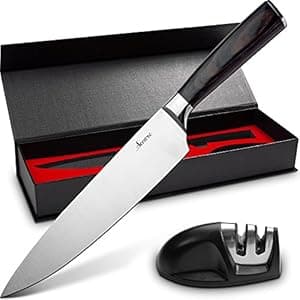 B0728P1MJM Availability: Currently unavailable Score: 6.289 Category: Home Rating: 4.7 Votes: 15 Find similar productsSharp 8'' Chef Knife & Sharpener, Balanced Quality Stainless Steel Blade: Easily Cut Sushi, Sashimi, Chicken Meat & More, Professional Cutting, Chopping, Slicing & Dicing, Ergonomic Kitchen Equipment. Look No Further for the Perfect Chef's Knife – Crafted for Culinary Perfection Professional chefs all agree there are three knives that are a must have for any kitchen: The chef’s knife, the paring knife and the serrated knife. The Secare Chef’s Knife checks all the boxes for the perfect, go-to knife whether you’re a pro working in a fancy restaurant or a mom or dad cooking a simple meal for the family. If you like to cook, this knife is a must have and will make your life easier! Our knife is designed with the same specs as knives forged in Germany or Japan. In addition, you get a sharpener included in the package, so you can focus on your cutting knowing that your blade has a sharp edge and is ready to go every time you pull it out. Our wood handle is crafted with ergonomics in mind and provides better grip and stability for hours of use. It won’t cramp your hand no matter how long you’re holding it. The wood is natural and more comfortable than plastic, ceramic material or rubber. Balance is key when choosing a knife, and our knife is forged with precision balance that allows the ultra-sharp blade to do most of the work for you making for a better, safer cutting experience in the kitchen. The Chef's knife by Secare is: An excellent chopper, slicer and cutter Easy to clean up! Wash in sink and towel dry for longevity Designed to be displayed proudly - classy, black design fits modern kitchens Built to be the best knife you’ve ever used The ideal gift to a friend – elegant packaging and complimentary sharpener make it into a great gift set for women and men who love cooking! Don't waste time switching between numerous knives, none of which fit quite right or cut sharp enough to get the job done the right way, resulting in tears and deformations in your meat and vegetables. Order the best chef’s knife you’ll ever use today!. |
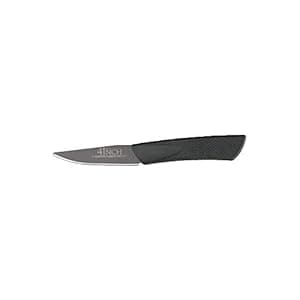 B07YF3TQNY Availability: Currently unavailable Score: 6.289 Category: Home Rating: 5 Votes: 1 Find similar productsSandrin 4inch Tungsten Carbide Knife. Sandrin Knives has done the impossible - create a tungsten carbide knife blade that isn't brittle. It is the only blade in the world made of tungsten carbide, and it’s rated at 71 Rockwell C. This industry-wide success story starts at the legendary Italian metallurgical company, Turmond SPA, where they developed a proprietary breakthrough method for using tungsten carbide in truly revolutionary ways. In so doing, they developed the most technically advanced Chef knife ever made. This engineered metal is capable of so much more than regular steel. Because of the properties of this special compound, functional stresses are setting new standards for the knife industry, as demonstrated by the Sandrin TCK folding knife. Since the engineered tungsten carbide blade is now the hardest knife blade in the world, this unique knife can probably be called - The Knife That Will Last Forever! It's not an exaggeration. This is a knife that gets sharp and STAYS sharp. Even with repeated, rugged use, these patented tungsten carbide blades will keep their edge and remain razor sharp vastly outperforming steel knives. Sure, nothing lasts forever, but with industry applications showing that a carbide edge lasts up to 20 times longer than steel, this sure comes close! A sharp knife is easier to control and the Sandrin 4inch will stay sharp up to 20x longer than traditional steel knives making it safer to use. Also, since this knife achieve an amazing 71 Rockwell, it won't leave behind microscopic particles in your food the same way steel knives do. The 4inch blade is sharpened to a combined final angle of 21 degrees which allows for a very fine and durable cutting edge while being as wear resistant as possible. The rounded tip helps prevent any accidental cuts as this blade will stay VERY sharp for a long time. Specs - OAL: 8.66, Blade: 5, Thickness: 0.36, Edge: 21deg, Grind: Flat, Edge Type: Hollow Grind, Handle Material: PA11. | 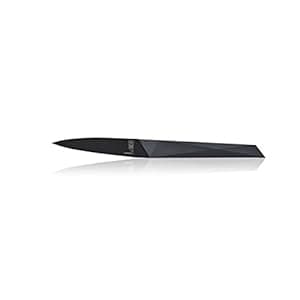 B00GQ631RG Price: $86.99 Score: 6.211 Category: Home Rating: 3.2 Votes: 8 Find similar productsTB Groupe - Furtif Evercut Paring Knife - Up to 25 Years Without Requiring Sharpening - Stainless Steel Knife - Made in France - 3.5”. Furtif Evercut Paring Knife - Long lasting edge: up to 25 years! - Lifetime warranty: unique serial number - Made in Thiers, France - Tempered stainless steel - ABS handle An essential paring knife This Furtif Evercut paring knife is an essential tool to handle smaller cutting tasks, such as peeling, coring, and pitting. The faceted handle is made of ABS, a lightweight polymer with exceptional resistance to heat, impact and detergents. Up to 25 years without requiring sharpening This knife features the Evercut Technology from French knife maker Tarrerias-Bonjean, a revolutionary innovation that allows this knife to retain its sharp edge for up to 25 years without requiring sharpening! It is achieved by laser-bonding Titanium Carbide, one the hardest materials available on Earth, to a hardened steel blade. Edge-durability world record holder According to certified results from CATRA Laboratory, Evercut blades retain their edge sharp for 6600 cutting cycles, which is 300 times longer than conventional steel blades (17 cycles) and up to 5 times longer than ceramic blades (1200 cycles). These results translate approximately in 25 years of domestic use without requiring any sharpening or honing at all. Crafted from one single piece of stainless steel The full tang blade is crafted in Thiers, France from one single piece of tempered stainless steel for additional strength and stability. It’s then fitted with a black PVD non-stick coating and inspected up to 20 times to ensure a sharp and perfectly balanced knife. Made in France Known for the quality of its products, TB Groupe has been creating high quality knives in Thiers, France since 1648. From the initial design to the finishing touches, the company’s search for quality is omnipresent throughout its knife manufacturing process. |
 B07VRLBZQX Availability: Currently unavailable Score: 6.211 Category: Home Rating: 4.3 Votes: 45 Find similar productsYoshihiro Mizu Yaki Aogami Super Blue High Carbon Steel Kurouchi Gyuto Chef’s Knife (8.25'' (210mm) & Saya, Octagonal Rosewood Handle). Knife Features → Blade Material: Blue Steel Super →Edge Angle: Double Edged →Grade: Mizu Yaki Kurouchi→Handle Shape: Octagonal→Handle Material: Rosewood→HRC:64-65→Knife Style: Gyuto Chef Knife →Saya Cover: Optional Lacquered Magnolia Saya Knife Cover →Stain Resistant: No Our handmade Yoshihiro Aogami Super Blue High Carbon Steel Kurouchi Series are unparalleled in their performance. The Black Forged 'Kurouchi' finish consists of the carbonized coating created during heat treating and provides for a characteristic look and a rustic aesthetic to the blade. Super Blue High Carbon Steel with a hardness on the Rockwell scale of 64-65 is considered to be the top of its class in high carbon steel metallurgy. The most versatile and essential of all knives a cook can have is a Japanese chefs knife known as a Gyuto knife. The Gyuto is a Japanese chefs knife with a curved blade that smoothly rocks back and forth and has an extended tip for quick chopping that can be used to cut meat, fish, and vegetables. Proudly made in Japan and not mass produced. This knife is complimented with a traditional Japanese Wa-style handcrafted Handle that is lightweight and ergonomically welds to the hand for seamless use. An optional and recommended protective wooden sheath called a Saya can be purchased together, which protects the knife and adds to its appearance when not in use. Traditional Japanese knife making values a sharp edge, which requires attention and care. Sharpening and honing should be done with only water whetstones. Hand wash and dry only, and do so immediately if working with acidic ingredients. Do not use on objects such as bones, nutshells, and frozen foods. Carbon steel can oxidize if not properly maintained. Keep dry and oil regularly to prevent oxidation. |  B001XCWGNS Availability: Currently unavailable Score: 6.173 Category: Home Rating: 5 Votes: 9 Find similar productsVictorinox Fibrox Sandwich Knife, 10-Inch, White. Victorinox Swiss Army Cutlery Who is Victorinox? Although Victorinox is known the world over as the creator of the Original Swiss Army Knife, the company started out in 1884 as a cutlery workshop. By the time company creator Karl Elsener delivered his first pocket knife to the Swiss Army, his cutlery business was already booming. Over the next century, Victorinox cutlery became a top-rated choice among professionals worldwide, with over 300 blades to offer. Victorinox knives have regularly appeared as highly ranked and recommended kitchen tools in Cook's Illustrated, Men's Health, The Cincinnati Enquirer, New York Magazine, and Natural Health, just to name a few. In 2009, the company announced a partnership with professional chef, Daniel Humm, of Eleven Madison Park in New York City. In addition, building on the success of its cutlery business, Victorinox has brought all the same quality and expertise to a wider range of products and accessories, including other kitchen tools, pocket tools, watches, luggage, and clothing. Who is R.H. Forschner? Victorinox had been a staple in European commercial cutlery for over 50 years when approached by New York's R.H. Forschner, known since 1855 as a builder of scales for butchers, to be their sole cutlery supplier. The two companies joined forces in 1937, and R.H. Forschner subsequently became North America's dominant professional brand, as ubiquitous in the bustling meatpacking plants of the Midwest as it is in the gleaming, four-star restaurant kitchens of Midtown Manhattan. As a division of Victorinox/Swiss Army Brands, R.H. Forschner marketed cutlery under the brand name RH Forschner by Victorinox and distributed to the commercial, food service, and retail trade classes. That brand has been considered a top choice of professionals worldwide with over 300 styles of blades bearing the R.H. Forschner name. However, in 2009, in conjunction with Victorinox's 125th anniversary, the company, Victorinox Swiss Army, Inc., has decided to remove the RH Forschner name from all blades. Blades thenceforth only include the Victorinox name. What is a stamped blade? A stamped knife can usually be identified by the absence of a bolster. Stamped blades are cut into their shapes from cold-rolled pieces of steel and then ground, tempered, and sharpened. Creating them requires many less steps than forging and results in lighter, narrower blades. Some professionals prefer the thicker, heavier forged blades, but many pros, who spend much of their day cutting and slicing, enjoy a lighter knife since it's less fatiguing and easier to manipulate at speed. Stamped knives are easier to produce and therefore less expensive. They perform very well and can approach the quality of a forged blade, but not the weight or feel. Victorinox manufactures a complete range of stamped blades with unique, patented Fibrox handles and they are considered among the greatest values in the knife industry. What knives do I need to own? Knife choice or selection is determined by many factors--size, function, style, and preference. The most important factor is function. Different knives have different uses. It is important to use the proper knife for a specific task, since proper knife selection and the use of a proper-sized, sharp knife make for safe cutting. General kitchen tasks and the knife to use for them are as follows: Paring: The most common to own and use, a paring knife is generally for small cutting jobs and peeling of vegetables or fruit. The blade size is usually from three to four inches. Choose the shape and size to fit your hand. Since this is one of the more versatile knives, owning more than one is recommended. Paring: The most common to own and use, a paring knife is generally for small cutting jobs and peeling of vegetables or fruit. The blade size is usually from three to four inches. Choose the shape and size to fit your hand. Since this is one of the more versatile knives, owning more than one is recommended. Chef's: The most important tool and essential to every cook, a chef's knife is most often used in a rocking method to mince, dice, and chop vegetables and herbs. This one is known as the chef's best friend. Chef's: The most important tool and essential to every cook, a chef's knife is most often used in a rocking method to mince, dice, and chop vegetables and herbs. This one is known as the chef's best friend. Slicer: Most commonly used to slice meats, poultry, and seafood, the slicer is an important companion to any host or hostess. Slicer: Most commonly used to slice meats, poultry, and seafood, the slicer is an important companion to any host or hostess. Boning: As its name suggests, a boning knife is used to trim or remove meat and fish from the bone. Boning: As its name suggests, a boning knife is used to trim or remove meat and fish from the bone. Bread: Designed with a special edge, a bread knife makes easy work of cutting through crusty bread, pastries, or any item with a crust and a soft interior. Bread: Designed with a special edge, a bread knife makes easy work of cutting through crusty bread, pastries, or any item with a crust and a soft interior. Fillet: Most often used by pros and seasoned home chefs, the fillet knife is used to fillet meat and fish. Fillet: Most often used by pros and seasoned home chefs, the fillet knife is used to fillet meat and fish. Cleaver: An important addition to any collection, a cleaver is often used to cut or chop through bones. Cleaver: An important addition to any collection, a cleaver is often used to cut or chop through bones. Santoku: This knife combines the features of a cleaver with a chef's knife. The curved blade helps the rocking motion used for chopping, and the wide blade works well for scooping sliced food off a cutting board and for crushing garlic. The santoku can also be used to slice meat and has a narrow spine for making thin cuts. Santoku: This knife combines the features of a cleaver with a chef's knife. The curved blade helps the rocking motion used for chopping, and the wide blade works well for scooping sliced food off a cutting board and for crushing garlic. The santoku can also be used to slice meat and has a narrow spine for making thin cuts. Utility: An all-purpose knife often referred to as a sandwich knife, the utility knife peels and slices fruits and vegetables, and even carves small meats. Utility: An all-purpose knife often referred to as a sandwich knife, the utility knife peels and slices fruits and vegetables, and even carves small meats. Shaping: With its curved blade, a shaping knife is great for small precision cuts where control is essential, such as peeling, trimming, or garnishing. Shaping: With its curved blade, a shaping knife is great for small precision cuts where control is essential, such as peeling, trimming, or garnishing. What are the different knife edges and what do they do? Straight: The vast majority of Victorinox knives come with a straight or fine edge. This means it has a perfect taper along the blade and no serrations. It is designed to cut without tearing or shredding. Straight: The vast majority of Victorinox knives come with a straight or fine edge. This means it has a perfect taper along the blade and no serrations. It is designed to cut without tearing or shredding. Serrated: An edge designed with small, jagged teeth along the edge. Serrated: An edge designed with small, jagged teeth along the edge. Scalloped: A blade with waves along the edge generally used to cut breads with a hard crust and soft interior, as well as tougher-skinned fruits and vegetables. Scalloped: A blade with waves along the edge generally used to cut breads with a hard crust and soft interior, as well as tougher-skinned fruits and vegetables. Granton: This edge has hollowed-out grooves or dimples on the sides of the blade. These grooves fill with the fat and juices of the product being cut, allowing for thin, even cuts without tearing. Even with the grooves, these are still straight-edge knives and can be honed with a sharpening steel. Granton: This edge has hollowed-out grooves or dimples on the sides of the blade. These grooves fill with the fat and juices of the product being cut, allowing for thin, even cuts without tearing. Even with the grooves, these are still straight-edge knives and can be honed with a sharpening steel. How should I care for my cutlery? After use, knives should not be allowed to soak in water. The best practice is to hand wash and dry them immediately. This is especially true if they have been used on fruit or salty foods, which may cause some staining, even on stainless steel. Most knives require very little maintenance and it is worth the effort to protect your investment. Though Victorinox knives are dishwasher safe, this is strongly discouraged. The dishwasher's agitation may cause damage. Additionally, harsh detergents can be harmful and cause pitting and spotting on the blades. The handles may also discolor and develop a white film with constant use of the dishwasher. Plus, intense heat associated with dishwashers is not good for the temper of the blade. How do I keep my knives sharp? All quality knives require proper maintenance to keep them in perfect cutting shape. The best of edges will quickly dull if it strikes metal, glass, or Formica. A wooden cutting board makes the best cutting surface. And, if a slip occurs, a proper cutting board is safer for the user. Frequent use of a Victorinox sharpening steel will keep blades in tip top working condition. All straight-edge knives need steeling to keep their edges. How to Steel a Knife Steeling a Knife Hold the steel firmly in your left hand with the guard positioned to stop the blade should it slip. Hold the steel firmly in your left hand with the guard positioned to stop the blade should it slip. Hold the knife in your right hand and place on top part of steel as shown. Hold the knife in your right hand and place on top part of steel as shown. Raise back of blade one-eighth inch. Raise back of blade one-eighth inch. Now, moving the blade only, draw it across the steel in an arching curve, pivoted at your wrist. The blade tip should leave the steel about two-thirds of the way down. Now, moving the blade only, draw it across the steel in an arching curve, pivoted at your wrist. The blade tip should leave the steel about two-thirds of the way down. Repeat the same action with the Blade on the bottom side of the steel. Always maintain the same pressure and angle on both sides of the steel. Repeat the same action with the Blade on the bottom side of the steel. Always maintain the same pressure and angle on both sides of the steel. Repeat five or six times. Repeat five or six times. How should I store my knives? Safety is the biggest concern of storage, both to the user and to protect the knife's edge. Choices include a knife magnet, knife block, drawer insets, and also individual knife protectors. |
 B0BBNNXCH8 Price: $9.58 Score: 6.061 Category: Home Rating: 4.5 Votes: 7057 Find similar productsFarberware Edgekeeper 5-Inch Santoku Knife with Self-Sharpening Blade Cover, High Carbon-Stainless Steel Kitchen Knife with Ergonomic Handle, Razor-Sharp Knife, Black. Farberware is the #1 selling cutlery brand in the U. S. (Source: the npd Group, /retail tracking service. 52 weeks ending March 2016). Farberware Edgekeeper knives feature a sheath with innovated technology that is designed to automatically sharpen the blade with each use. The blade is made from high-carbon steel that lends strength, sharpness, and durability. This Santoku knife combines the best features of a chef's knife and a cleaver, with a wide, heavy blade that is ideal for chopping, slicing, and dicing. Not dishwasher safe. Hand wash with warm water and a mild detergent; rinse and dry immediately. . |  B09CL3WBDS Price: $48.42 Score: 6.061 Category: Home Rating: 4.8 Votes: 1192 Find similar productsVictorinox 8 Inch Rosewood Chef's Knife. A TRUSTED FAVORITEAn elegant addition to any kitchen, the 8 Victorinox Rosewood Chef's Knife can handle nearly every kitchen task imaginable. Crafted with a comfortable handle, superior weight and balance, and a razor sharp edge that rarely requires re-sharpening, this knife is an essential tool for every kitchen.KEY FEATURES High-quality, lightweight European steel. Handle design reduces hand and wrist fatigue. Fit for dicing, mincing, chopping, slicing, and shredding. Long, sloping curved blade that “rocks” for effortless mincing and chopping. Flat spine for extra power to slice through hard-skinned items. Hand polished rosewood handle for a secure and comfortable grip no matter the hand size. Dishwasher safe & easy to sharpen. CARE AND USEBe good to your knives and they’ll be good to you. Following these simple guidelines will ensure that you get the longest life out of your knife! CLEANINGVictorinox Swiss Army recommends washing all knives by hand. For best results, hand wash your knives with a soapy cloth and dry immediately. While Fibrox Pro knives are dishwasher safe, we recommend hand washing as dishwashers are designed to spray water at a relatively high pressure, which can jostle the silverware and cause the knives to collide, dulling the edge.SHARPENINGFor optimum performance, knives should be honed after every couple of uses. Proper and frequent use of a honing steel will keep your knives sharper and performing at their best.FORMERLY FORSCHNERIn 1937 Victorinox began selling cutlery in America through a Connecticut distributor called R.H. Forschner & Co. A well-known manufacturer of butcher scales, Forschner soon became the exclusive U.S. distributor for Victorinox knives, and was the name by which Victorinox knives were known. |